Table of Contents
- What to Look for in Desert Fitness Centers
- Gyms With Day Passes in the Coachella Valley
- Personal Training Services in the Desert
- Group Fitness Classes for Visitors
- 24/7 Access and Operating Hours
- Accessibility, Inclusivity, and Community Atmosphere
- How to Evaluate Desert Fitness Centers Before You Commit
- Frequently Asked Questions
Last Updated: September 10, 2026
What to Look for in Desert Fitness Centers
Finding local fitness centers in desert communities takes more planning than in milder climates, because heat reshapes everything from class schedules to building design. Visitors and new residents often sign up for the wrong gym because they judged it on photos instead of function.
The first thing to check is not the equipment. It’s the building itself.
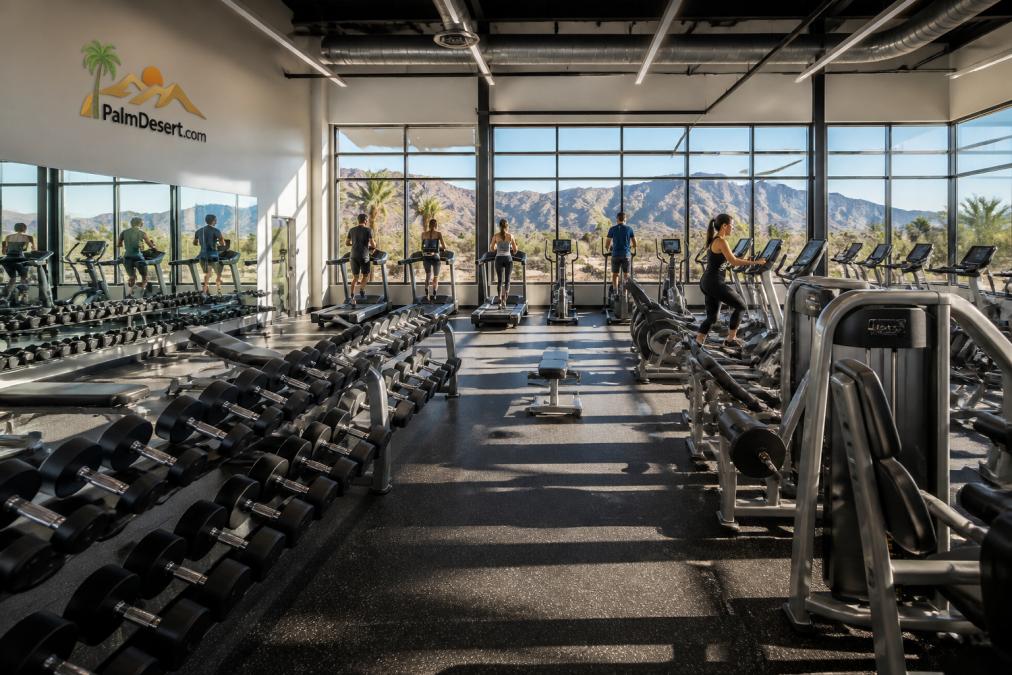
Desert gyms that hold up year-round share a few structural traits: high ceilings, powerful air handling, and workout floors positioned away from west-facing glass. According to U.S. Department of Energy guidance on cooling and building efficiency, interior heat gain is one of the largest drivers of discomfort in glass-heavy commercial spaces. A gym with a wall of untinted windows facing the afternoon sun will feel like an oven by 4 p.m., no matter how strong the air conditioning claims to be.
Then look at how the space is zoned. A good layout separates three things:
- Cardio machines, ideally near cooler zones and away from direct sun
- Free weights and Olympic lifting platforms, which need reinforced flooring and clearance
- Stretching areas and recovery amenities, which should feel calm rather than crowded
If those three zones bleed into each other, you’ll spend your workout dodging traffic.
Ask to tour a gym between 4 and 6 p.m., not mid-morning. That’s when the building’s cooling system faces its real test, and you’ll see exactly how the space handles peak heat and peak crowd at the same time.
Gyms With Day Passes in the Coachella Valley
Gyms with day passes in the Coachella Valley solve a specific problem: you’re here for a week, a month, or a season, and a twelve-month contract makes no sense. Most visitor-friendly facilities offer a single-day rate, a multi-day pack, or a short-term pass, and the differences between them matter more than the headline number.
How to Compare Day Pass Options
Compare day passes on four criteria, not one: what’s included, when you can use it, whether it covers classes, and how guest access works.
A pass that only unlocks the gym floor is not the same as one that includes group exercise, the pool, or recovery amenities. Confirm:
- Does the pass include group fitness classes, or is there a separate fee?
- Are there blackout hours during peak times?
- Can you bring a guest, and is there a guest fee?
- Does the pass cover the full facility, including locker rooms and showers?
- Is there a trial pass for first-time visitors, and what does it require?
Trial Pass and Guest Policy Comparison
This is the part most facility listings bury, and it decides whether a pass is worth buying. Use the table below as a framework when you call or visit each facility.
| What to Ask | Why It Matters | What to Write Down |
|---|---|---|
| Trial length | A one-visit trial tells you almost nothing about peak-hour comfort | Number of free visits, if any |
| Trial eligibility | Some facilities limit trials to first-time local residents only | Whether visitors qualify |
| ID and proof required | Determines whether you can walk in same-day | What you need to bring |
| Guest policy | Decides whether a friend or partner can join you | Guests allowed per visit, and any guest fee |
| Guest age rules | Matters if you’re traveling with teens or older family | Minimum age, waiver requirements |
| Class inclusion | The single biggest cost surprise on day passes | Whether group exercise is bundled or separate |
| Peak-hour limits | Some passes exclude weekday evenings entirely | Blackout windows |
| Auto-renewal terms | Short-term passes sometimes roll into monthly billing | Cancellation window and notice required |
Facilities offering the longest free trial often have the strictest guest rules, and those with generous guest policies tend to cap trial visits. Decide which matters more before you start calling.
Pass Types at a Glance
| Pass Type | Best For | What to Confirm |
|---|---|---|
| Single-day pass | Short stays, trying a facility | Class access, peak-hour limits |
| Multi-day pack | Week-long visits | Expiration window, guest policy |
| Seasonal or short-term | Snowbirds, extended stays | Cancellation terms, auto-renewal |
| Trial pass | First-time visitors | ID requirements, one-per-person rules |
The most common mistake with day passes is assuming classes are included. Many facilities charge separately for group exercise, so a pass that looks affordable on the gym floor can double in cost once you add a class. Ask before you pay.
Call three facilities in one sitting and fill in the comparison table while the details are fresh. Guest policies and trial rules change seasonally, and the person at the front desk is the only reliable source, websites are often a season behind.
Personal Training Services in the Desert
Personal training services in the desert emphasize two things city gyms often skip: hydration strategy and heat acclimation. A trainer who understands the local climate builds sessions around the reality that your body is already working harder just to regulate temperature.
What Heat Acclimation Actually Looks Like
Heat acclimation is progressive: the body adapts to training in warmer conditions over roughly one to two weeks of repeated exposure, producing earlier sweat onset, higher sweat rate, lower core temperature at a given workload, and better plasma volume retention (peer-reviewed research). Trainers who know this will typically:
- Start you at a lower intensity than your city baseline for the first several sessions
- Front-load hydration before the session rather than relying on mid-workout drinking
- Shift outdoor or non-air-conditioned work to early morning or after sunset
- Build in longer rest intervals during the first two weeks
- Reassess intensity weekly rather than daily, since adaptation is not linear
If a trainer writes you a program identical to what you’d get in a mild climate, that’s a signal they haven’t adjusted for the environment.
The Intake Process That Separates Good Trainers
What separates a good training program from a generic one is the intake process. A trainer worth hiring will ask about your goals, schedule, and how long you’re in the area before writing a single session. Expect questions about:
- Current training frequency and how recently you’ve trained in heat
- Any medications or conditions that affect heat tolerance
- Whether you’re a seasonal resident, a short-term visitor, or year-round
- What equipment and class formats you actually enjoy, since adherence beats optimization
If you’re a seasonal resident, ask whether they offer short-term packages rather than annual commitments. If you’re year-round, ask how they adjust programming across seasons, summer sessions often move earlier, shorten, or shift toward lower-intensity strength work.
Credentials and Facility Pairing
Before booking, confirm two things: the trainer’s certification and where they actually train. Many facilities require current CPR and first aid certification (the CDC). Ask which certification the trainer holds and how long they’ve trained clients in this climate.
A common mistake is booking a trainer before confirming they train at your chosen facility. Many work across multiple locations, and their availability may not match the gym where you hold a pass. Ask which facility they’re based at, which days they’re there, and whether your pass covers training sessions there.
Book Hotels with Exclusive Discounted Rates Now →
Ask a prospective trainer to describe how they’d change your first two weeks versus your fifth week. A trainer who can’t answer that specifically is not programming for the climate, they’re programming for a generic gym.
Group Fitness Classes for Visitors
Group fitness classes for visitors are one of the fastest ways to find community in a new area, and the desert has no shortage of options. The catch is scheduling: many facilities run popular classes early morning or late evening to avoid the worst heat, which can clash with a vacation itinerary.
When evaluating a class schedule, look for variety across formats rather than a single specialty. A facility offering strength and conditioning, functional fitness, suspension training, and low-impact options gives you room to adjust if the heat or your energy levels change. mind-body reset programs.
The best indicator of a class you’ll actually attend is the time slot, not the format. A well-run 6 a.m. class beats a perfect 2 p.m. class you’ll skip because it’s too hot to leave the hotel.
24/7 Access and Operating Hours
24/7 access sounds like a luxury until you realize how much it changes your routine in a desert climate. Training at 5 a.m. or 9 p.m. lets you work out during the genuinely comfortable hours and spend midday doing something else.
Not every facility that advertises extended hours offers true round-the-clock access. Some close for cleaning, lock the doors overnight, or restrict 24/7 entry to certain membership tiers. Ask directly:
- Is access truly 24/7, or are there overnight closures?
- Is after-hours entry controlled by key fob, app, or code?
- Is the facility staffed overnight, or is it monitored remotely?
- Does the 24/7 tier cost more than standard membership?
For snowbirds and long-term residents, 24/7 access is often worth prioritizing over premium amenities, because it’s the feature you’ll use every week rather than once a season.
Accessibility, Inclusivity, and Community Atmosphere
Accessibility and inclusivity are where most fitness facility listings tell you almost nothing, and where the real difference between gyms shows up. A facility can have excellent equipment and still be a poor fit if the entrance has steps, the locker rooms don’t accommodate everyone, or the culture makes certain members feel unwelcome.
Walk the facility and check the practical details: step-free entry, accessible parking, wide aisles between machines, adjustable equipment, and staff who can explain accommodations without being asked twice. These determine whether a gym works for you over months, not days.
Community atmosphere is harder to assess from a website but just as important. The clearest signal is whether staff greet people by name and members talk between sets. Facilities built around a genuine community retain members far longer than equipment warehouses, and for visitors building a social circle, that culture is often the deciding factor.
Visit at the same time on two different days before committing. If the same faces show up both times and the front desk recognizes them, you’ve found a facility with a real community, not just a membership list.
How to Evaluate Desert Fitness Centers Before You Commit
Evaluating fitness centers before you commit comes down to matching the facility to your actual routine, not the one you imagine having. Use a day or trial pass at two or three facilities during the hours you’d realistically work out, then compare them against the same criteria.
Here’s a simple scoring method. Rate each facility from 1 to 5 on six factors, then weight them by what matters most to you:
| Factor | What to Score | Weight If You’re a Visitor | Weight If You’re a Resident |
|---|---|---|---|
| Cooling and comfort | Airflow, shade, temperature at peak hours | High | High |
| Pass flexibility | Day, multi-day, short-term options | High | Low |
| Class schedule | Times and formats that fit your routine | Medium | High |
| Access hours | True 24/7 vs. limited | Medium | High |
| Accessibility | Step-free entry, equipment, staff support | Medium | Medium |
| Community | Staff recognition, member interaction | Low | High |
For a one-week visit, cooling and pass flexibility decide it. For a seasonal or year-round stay, access hours and community carry more weight. The mistake most people make is scoring every facility on the same criteria regardless of how long they’ll actually be there.
Once you’ve picked a facility, the rest of your planning gets easier. If you’re still sorting out where to stay, our directory of Palm Desert hotels and resorts and our Palm Desert vacation rental homes let you choose a base within easy reach of the gyms you’re considering. The Visitor Center for Palm Desert & Palm Springs also maintains a travel planning hub and a local blog with current facility and event information, so your fitness routine and itinerary can be planned together.
The hardest part of finding local fitness centers in desert communities isn’t locating them, it’s choosing one that still fits your routine once the novelty wears off. The Visitor Center for Palm Desert & Palm Springs helps you narrow that choice with curated local guides, up-to-date facility and event listings, and trip planning tools built for visitors and residents. Browse our hotel and vacation rental directories, check the local blog for current openings and schedules, and subscribe to our weekly updates so your next workout is sorted before you arrive.
Frequently Asked Questions
What is the best fitness club for seniors in the Coachella Valley?
The best club for seniors depends on what you value most. Look for facilities with low-impact group fitness classes, accessible equipment, and a welcoming community atmosphere. Many desert fitness centers offer senior-specific programs like chair yoga, water aerobics, and gentle strength training. Visit during off-peak hours to see how the gym feels, and ask about age-based membership discounts. Some centers also coordinate with Medicare Advantage plans that include fitness benefits, so check with your insurance provider before committing.
Do local fitness centers offer short-term passes for vacationers?
Many gyms with day passes in the Coachella Valley cater specifically to visitors. You can often buy a single-day pass or a weekly pass without a long-term contract. Some facilities bundle passes with personal training sessions or group fitness classes for visitors. Call ahead or check the gym’s website to confirm availability, especially during peak season from January through March when snowbirds arrive. Bringing a valid ID and arriving outside peak hours can make the process smoother.
Are there 24-hour gym options available in the local area?
Several desert fitness centers offer 24/7 access, typically through a key fob or app-based entry system. These are most common at larger chains and standalone gyms rather than boutique studios. If you need late-night or early-morning workouts, confirm that the location you are considering actually staffs the facility overnight or relies on camera monitoring. Ask about emergency procedures and whether the weight room and cardio areas remain fully accessible during unstaffed hours.
What amenities should I look for in a high-end desert fitness facility?
Beyond standard cardio machines and free weights, high-end desert fitness centers often include recovery amenities such as saunas, cold plunge pools, and stretching areas. Some offer childcare, towel service, and smoothie bars. If you plan to visit during summer, prioritize strong air conditioning and indoor turf areas for functional fitness. Also check whether the facility provides group exercise studios, Olympic lifting platforms, and suspension training equipment. Tour the gym in person or request a virtual walkthrough before committing.