
Table of Contents
- Is The Living Desert Zoo Worth Visiting With Toddlers? The Short Answer
- What Toddlers Can Actually See and Do at The Living Desert
- The Living Desert With Kids: Layout, Walking Distance, and Stroller Logistics
- The Living Desert Stroller Tips and Practical Gear
- Heat, Shade, and Weather: Planning Your Visit by Season
- The Living Desert Zoo Visit Duration: How Long Should You Stay?
- Admission, Tickets, and Value for Money With Young Children
- Toddler-Specific Logistics: Food, Bathrooms, and Rest Breaks
- Is It Worth the Trip? A Realistic Family Verdict
- Frequently Asked Questions
Last Updated: October 12, 2026
Is The Living Desert Zoo Worth Visiting With Toddlers? The Short Answer
Yes, is the living desert zoo worth visiting with toddlers, but it takes smart planning. The Living Desert works well for young children because it combines animal viewing, hands-on activities, and water features in a manageable setting. The real question isn’t whether your toddler will enjoy it. It’s whether you can handle the heat, the walking, and the logistics of keeping a small child comfortable for a few hours.
The truth is straightforward: this zoo delivers genuine value for families with toddlers, but only if you time your visit right and come prepared. Let’s break down what actually works here, and what doesn’t.
What Toddlers Can Actually See and Do at The Living Desert
Animal Viewing and Giraffe Feeding
The main draw for young kids is the giraffe feeding experience. Toddlers can watch giraffes eat from your hand (or from a parent’s hand, depending on age). This hands-on moment creates a real memory. Beyond giraffes, your child can see zebras, antelopes, and other desert wildlife in open habitats. The viewing areas are designed so kids can actually see the animals without climbing or straining.
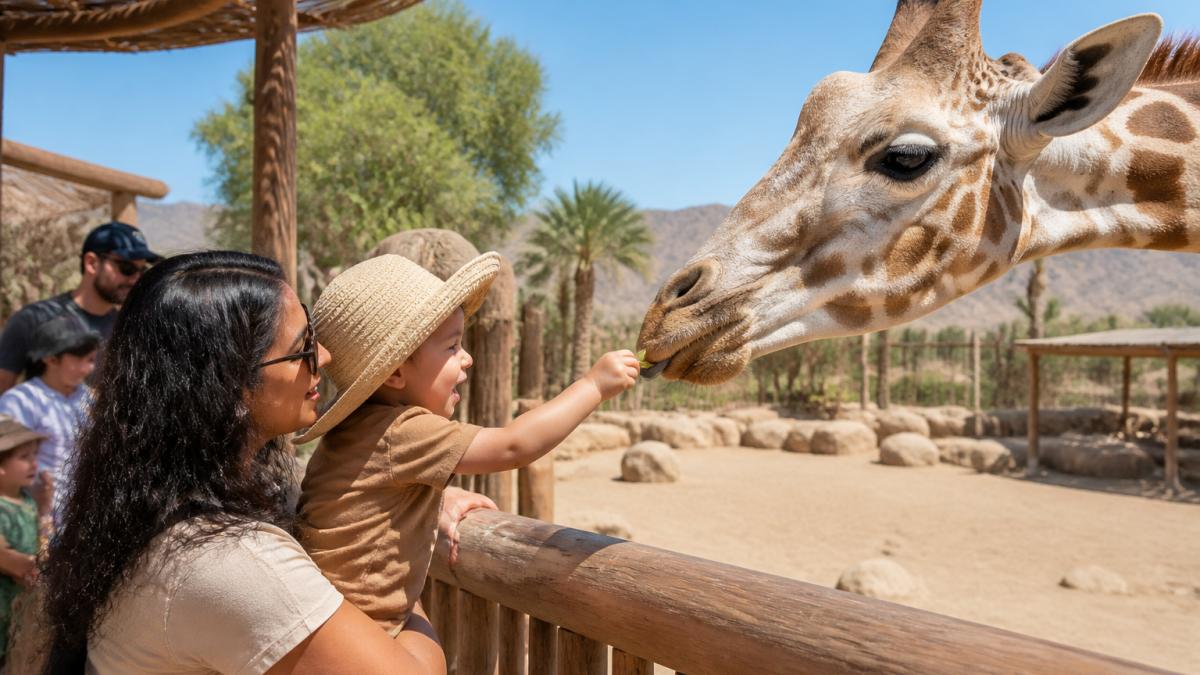
Other animal encounters include:
- Walk-through aviary where birds move around you
- Goat petting area (always a hit with young kids)
- Desert reptiles and small animals in viewing stations
- Occasional keeper talks (though timing is unpredictable)
The animals are spread across the property, so you’ll do a fair amount of walking. That’s both good and bad. It keeps things interesting, but it also means your toddler needs to be mobile or you need a stroller.
Play Areas and Hands-On Activities
Beyond animals, the zoo includes play structures designed for young children. There’s a small carousel and a model train ride (both require separate tickets or are included depending on your admission package). These give toddlers a break from walking and animal viewing.
Play areas feel low-key compared to major theme parks. That’s actually an advantage for families with toddlers, less overwhelming, easier to manage, and less crowded. Your child won’t face massive lines or sensory overload.
Activities that work well for toddlers:
- Climbing structures in designated play zones
- Model train ride (short duration, perfect for short attention spans)
- Carousel rides
- Interactive touch pools (seasonal, water-based learning)
Water Features for Cooling Off
The zoo includes water features designed for hot-weather relief. There’s a splash pad and small water play area where toddlers can cool off. This is critical during summer months when temperatures exceed 100°F.
The water features are modest, not a full water park. But for a toddler, a small splash pad is often enough to reset their mood and energy level. You’ll want to bring a change of clothes or a quick-dry shirt.
The Living Desert With Kids: Layout, Walking Distance, and Stroller Logistics
The property spans roughly 60 acres, but the main toddler-friendly areas are more condensed. You won’t walk the entire zoo unless you choose to. Most families with young kids focus on the giraffe feeding, play areas, and animal viewing near the entrance.
Walking distance for toddlers:
- Giraffe feeding to main play area: about 5-10 minutes
- Play area to water features: 10-15 minutes
- Full loop of toddler-friendly zones: 45 minutes to 1 hour
A stroller is nearly essential. The paths are paved and stroller-friendly. If your toddler can walk short distances but needs breaks, a stroller lets you cover ground without exhaustion. Many families rent strollers on-site, though bringing your own gives you more control.
Stroller considerations:
- Paths are smooth and accessible for standard strollers
- Shade is limited in many areas (bring a stroller canopy)
- Some areas have benches for breaks
- Renting on-site is an option but adds to your cost
The layout feels manageable because you’re not forced to walk miles to see animals. The zoo is designed so you can see major attractions without traversing the entire property. This is a real advantage for families with toddlers compared to larger zoos.
The Living Desert Stroller Tips and Practical Gear
Most family guides stop at “bring a stroller.” The harder questions are the ones that actually decide whether the day goes smoothly: where does a toddler nap, where do you change a diaper without a line, and how do you feed a hungry kid without derailing the visit. Here is the caregiver-level version.
Stroller choice and setup
The paths through the main toddler-friendly zones are paved and firm, so a standard stroller rolls fine. A few practical notes:
- A canopy or clip-on sunshade matters more than suspension. Large stretches of the walkable areas have limited shade, and a toddler sitting still in a stroller heats up faster than one who is walking.
- A small battery-powered stroller fan clipped to the frame is one of the highest-return items you can bring. It keeps air moving during rest breaks and nap attempts.
- If you are deciding between an umbrella stroller and a larger one, the larger stroller wins here. You want the storage basket for water, snacks, and a change of clothes, and you want a seat that reclines for naps.
- Wagons are popular with families, but check the current posted policy before you load one in the car, since rules on wagons and pull-behinds change.
Nap logistics
Toddler naps are the single biggest scheduling constraint, and the heat makes them harder. A few patterns that work:
- Plan the visit so the stroller nap happens on the way out, not in the middle. Walk the shaded or indoor stretches while your child sleeps, then leave.
- Air-conditioned indoor spaces (the gift shop, restroom buildings, and any indoor exhibit space) are the most reliable nap and reset spots when it is hot.
- A reclined stroller in shade beats a bench. Benches are scattered around, but they are not designed for a sleeping toddler.
Diaper changes and feeding
- Restroom buildings have changing tables, but they are busiest right after opening and around midday. Change your toddler before you start the loop rather than mid-loop.
- Bring a portable changing pad. Even with facilities available, a pad gives you a clean surface anywhere and lets you handle a quick change in a shaded, quiet spot instead of walking back to a restroom.
- For feeding, pack a lunch and snacks rather than relying on vendors. Vendor lines peak at lunch, and a hungry toddler in a line is the fastest way to end the visit early.
- If you are nursing or bottle-feeding, the shaded ramadas and indoor spaces give you a calmer option than a sunny bench. A nursing cover and a small cooler bag for bottles make this easier.
Sensory and mobility considerations
Not every toddler handles a zoo the same way. A few things to plan around:
- Noise is concentrated near keeper talks, the carousel, and the train. If your child is noise-sensitive, do those activities early or skip them and spend the time in the quieter animal-viewing areas.
- Crowds build through the morning. Arriving at opening gives you a calmer first hour, which is often the difference between a good visit and a meltdown.
- Walking surfaces are firm and generally even, but distances between animal areas add up. If your toddler has limited stamina or uses a mobility device, plan the short loop and use the stroller between stops.
- Bring noise-reducing headphones if your child uses them at home. They take up almost no space and can rescue a visit.
Pack a small “reset kit” in the stroller basket: a change of clothes, a spare diaper, wipes, a refillable water bottle, a snack, and a small shade cloth. Having it within arm’s reach means you handle most toddler emergencies without walking back to the entrance.
Heat, Shade, and Weather: Planning Your Visit by Season
This is where is the living desert zoo worth visiting with toddlers gets complicated. Heat is the biggest factor.
Summer (June-August):
- Temperatures often exceed 110°F by mid-afternoon
- Not recommended for toddlers unless you go very early (before 9 a.m.)
- Heat exhaustion risk is real (the CDC)
- Afternoon visits are nearly impossible
Fall (September-November):
- September is still hot (95-105°F)
- October and November are ideal (75-90°F)
- Comfortable for toddlers with normal precautions
- Best time to visit
Winter (December-February):
- Perfect temperatures (65-75°F)
- Peak season (busier, but still manageable)
- No heat stress on your child
- Ideal for families with toddlers
Spring (March-May):
- Warming trend (80-95°F)
- Still comfortable for toddlers
- Less crowded than winter
- Good balance of weather and crowds
Shade availability:
- Some areas have ramadas (open-sided shade structures)
- Many paths have minimal shade
- Bring or rent a stroller with canopy
- Plan indoor breaks (gift shop, restrooms have air conditioning)
Heat management strategy:
- Visit October through April
- Start early (8 or 9 a.m.)
- Take breaks in shaded or air-conditioned areas
- Avoid midday (11 a.m.-3 p.m.)
- Drink water constantly
The Living Desert Zoo Visit Duration: How Long Should You Stay?
Most families with toddlers spend 2-3 hours at the zoo. This is enough time to see the main attractions without exhausting your child or yourself.
Realistic visit breakdown:
- Arrival and giraffe feeding: 30-45 minutes
- Animal viewing and walking: 45-60 minutes
- Play area and carousel: 30-45 minutes
- Water features and breaks: 20-30 minutes
- Total: 2-3 hours
A full day (5-6 hours) is possible but not necessary for toddlers. Shorter visits are often better. Your child stays happy, you avoid meltdowns, and everyone leaves on a high note.
Book Hotels with Exclusive Discounted Rates Now →
Factors that affect duration:
- Your toddler’s energy level and walking ability
- How much time you spend at play areas
- Whether you take multiple breaks
- Crowds (busy days mean more waiting)
Pro tip: Visit on weekdays if possible. Weekends and school holidays bring larger crowds, which means longer waits and more stress for families with young children.
Admission, Tickets, and Value for Money With Young Children
This is where most family guides get vague, and it is the section that actually determines whether the visit is worth it. The honest answer is that value depends less on the ticket price and more on how many of the toddler-usable activities are included versus sold separately.
What general admission typically covers
General admission is designed to cover the core experience: walking the grounds, viewing the animal habitats, the walk-through aviary, the goat petting area, the reptile and small-animal viewing stations, and the play structures. For a toddler, that core is genuinely the bulk of the day.
What is commonly separate or limited:
- The giraffe feeding experience is the headline draw, and it is often a separately ticketed add-on with limited daily slots. Confirm current status before you promise your toddler a giraffe.
- The model train ride and the carousel are typically ticketed individually or sold as a small ride package. Both are short, which suits toddler attention spans, but they are not free.
- Seasonal touch pools and any special programming may be included or may be limited to certain days.
Included-versus-extra details change seasonally at most zoos. Check the current ticketing page the week of your visit rather than relying on a guide written months earlier, including this one.
Age-based admission: the part parents miss
Most zoos use a tiered admission structure with a free or reduced tier for the youngest children and a child rate above a certain age. The practical implication for families:
- If your toddler falls under the free or reduced age threshold, the value calculation changes completely. You are essentially paying one adult admission for a half-day of toddler entertainment, which is a strong ratio.
- If your toddler is just above the threshold, you are paying a child rate for a child who may only engage with a fraction of the grounds. That is when the value question gets real.
- Bring proof of age if your child is near a threshold. Front-gate staff apply the posted rule, and having a document avoids a debate.
A toddler-focused value comparison
Instead of asking “is the ticket worth it,” ask “how many toddler-usable hours am I buying.” A realistic toddler visit is 2-3 hours, and the usable activities break down roughly like this:
- Giraffe feeding: 15-30 minutes, high engagement, often an add-on
- Animal viewing and walking: 45-60 minutes, included
- Play structures: 20-40 minutes, included
- Train and carousel: 10-20 minutes combined, usually ticketed
- Water features and cooling breaks: 20-30 minutes, included
If your toddler engages with the included animal viewing and play areas, the core ticket delivers. If your toddler’s attention is mostly captured by the giraffe feeding and rides, budget for the add-ons or accept that the included portion may only hold them for an hour.
Ways to protect the value
- Check whether a membership or season pass pays for itself if you are local or visiting for more than a few days. The break-even is usually two to three visits for a family.
- Visit during cooler months when you can stay longer. A 2-hour summer visit and a 4-hour winter visit cost the same, but the winter visit delivers roughly double the usable time.
- Bring your own food and water. Vendor pricing inside is higher than outside, and a toddler who eats a packed lunch is a toddler who does not need a mid-visit restaurant stop.
- Skip the add-ons on a first visit and see how your toddler responds to the included areas. You can always buy a ride ticket on the spot.
The value question is not “is the ticket expensive.” It is “how many hours of toddler-usable activity does the ticket unlock, and how many of those hours require an extra purchase.” Answer that before you buy.
Toddler-Specific Logistics: Food, Bathrooms, and Rest Breaks
Food options exist but are limited and expensive. Pack snacks and a lunch if possible. The zoo has a few vendors, but don’t rely on them for a full meal.
Food and hydration strategy:
- Bring plenty of water (at least 2-3 bottles per person)
- Pack snacks (crackers, fruit, granola bars)
- Consider a simple lunch or picnic items
- Avoid relying on food vendors for main meals
Bathrooms are available but can get crowded during peak hours. Locate them early so you know where to go. Bring wipes and hand sanitizer for quick cleanups.
Bathroom tips:
- Find restrooms near the entrance first
- Use them early before crowds build
- Bring extra diapers and wipes
- Changing tables are available in most restroom areas
Rest breaks are essential. Toddlers need downtime to recharge. Plan for 1-2 rest breaks during your visit.
Rest break strategy:
- Sit in shaded areas for 15-20 minutes
- Use indoor spaces (gift shop, visitor center) for air-conditioned breaks
- Let your child rest in the stroller if needed
- Don’t push through exhaustion, leave early if your child is done
A realistic toddler visit includes:
- Early arrival (8-9 a.m.)
- Giraffe feeding and animal viewing
- Play area time
- Rest break in shade
- Water feature time or additional animal viewing
- Departure by early afternoon
This rhythm keeps your toddler happy and prevents meltdowns.
Is It Worth the Trip? A Realistic Family Verdict
Is the living desert zoo worth visiting with toddlers? Yes, if you plan correctly.
The Living Desert delivers real value for families with young children. Your toddler will see animals up close, touch giraffes, play in designated areas, and cool off in water features. These are genuine experiences that create memories.
The trade-offs:
- Heat is a real concern (visit October-April)
- Walking and logistics require planning
- The experience is shorter than larger zoos (2-3 hours is typical)
- Food and extras can add costs
When it’s worth the trip:
- You have a toddler who enjoys animals
- You visit during comfortable weather (fall, winter, spring)
- You’re willing to plan for heat, shade, and breaks
- You want a low-stress family outing
When it might not be worth it:
- You’re visiting in summer (too hot for toddlers)
- Your child has limited mobility or energy
- You expect a full-day theme park experience
- You’re on a tight budget and can’t manage food costs
The verdict: The Living Desert is worth visiting with toddlers. Plan for 2-3 hours, visit during cooler months, bring water and snacks, and focus on the giraffe feeding and play areas. Your toddler will have a good time, and you’ll avoid the stress of a larger, more complicated zoo visit.
For more family-friendly activities and accommodations in the area, explore our vacation rental homes for your stay or browse our directory of Palm Desert hotels and resorts to plan your full trip.
Frequently Asked Questions
How much time do you need at The Living Desert Zoo with toddlers?
Plan 2-3 hours for toddlers under age 4, or 3-4 hours for older kids who want to explore more. Most families with young children spend the morning or early afternoon to avoid peak heat and afternoon fatigue. A shorter visit focused on the animal habitats, play areas, and water features keeps toddlers engaged without overwhelming them or pushing nap schedules.
What should parents bring for a toddler’s visit to The Living Desert?
Bring plenty of water, sunscreen, a wide-brimmed hat, and lightweight layers for shade breaks. Pack snacks, diapers, and wipes. A stroller is essential for toddlers under 3, and comfortable walking shoes for parents are critical since the terrain covers several miles. Consider bringing a small blanket or portable shade for rest breaks, and check what food options are available on-site before your visit.
Is The Living Desert Zoo manageable with a stroller?
Yes, strollers are manageable on most pathways, though some areas have uneven terrain and gentle slopes. Many families use strollers for younger toddlers but find that older toddlers (ages 3-4) enjoy walking parts of the zoo while riding in the stroller for longer stretches. Lightweight, all-terrain strollers work better than standard models. Stroller rentals may be available, so check ahead if you prefer not to bring your own.
What is the best age to take a child to The Living Desert Zoo?
The Living Desert works for all ages, but toddlers ages 2-4 enjoy it most because they’re old enough to notice and react to animals but still benefit from strollers for rest. Children under 2 may not engage as much with the exhibits. Older kids (5+) can walk longer distances and appreciate more details about the animals and desert habitats, making visits more interactive and memorable.
Planning a family trip to the desert? The Living Desert is one option, but the real value comes from pairing it with comfortable accommodations and other activities suited to your family’s pace. At the Visitor Center for Palm Desert & Palm Springs, we help families like yours build trips that work for toddlers and parents alike. Browse our curated selection of vacation rentals and hotels to find the perfect base for your desert visit. Your family’s comfort starts with where you stay.