
Last Updated: November 27, 2026
Quick Summary
Plan a desert weekend getaway backwards: set your maximum drive time first, then choose a destination that fits it. Pick spring or fall for mild days, book lodging and timed-entry permits early, and pack layers for hot afternoons and cold nights.
- Treat drive time as a hard limit: under 2 hours for a light Friday-night drive, over 6 hours means plan three days.
- Build three anchors per day, not eight, and leave the gaps empty on purpose.
- Check tires, coolant, battery, and lights, and fill the tank before long empty stretches.
- Hike before 10 a.m. and turn around at half your water.
- Screenshot confirmations and park pages before you lose signal.
Table of Contents
- Start With Drive Time, Not a Wish List
- Pick Your Season: The Best Time to Visit the Desert
- Build a Desert Weekend Itinerary That Leaves Room to Breathe
- Desert Road Trip Planning: Routes, Fuel, and Vehicle Checks
- Book Lodging That Matches How You Want to Spend the Weekend
- Reserve Parks, Tables, and Timed Entry Before You Leave
- Your Desert Trip Packing List, Built for Heat and Cool Nights
- Heat, Water, and Emergency Planning for a Desert Weekend Getaway
- Set Up Your Trip Plan With Local, Current Information
- Frequently Asked Questions
Start With Drive Time, Not a Wish List
A desert weekend getaway works best when you plan it backwards. Start with how far you’re willing to drive, then pick the destination that fits. Most people do the opposite, and they end up with a five-hour haul and two hours of actual relaxation.
At Visitor Center for Palm Desert & Palm Springs, we’ve seen that the travelers who enjoy their trip most are the ones who treat drive time as a hard limit, not a detail.
Here’s a simple way to set that limit:
- Under 2 hours: a light Friday-night drive, full Saturday, easy Sunday
- 2 to 4 hours: leave Friday afternoon, arrive before dark
- 4 to 6 hours: take Friday off or fly in
- Over 6 hours: a weekend is too short; plan three days
Write your number down before you open a single map. It decides everything else.
Federal Highway Administration travel and road data
If you’re mapping the whole trip, our guide on how to plan a desert trip efficiently walks through drive times, packing, and where to stay in one place.
Pick Your Season: The Best Time to Visit the Desert
The best time to visit the desert is spring or fall, when daytime temperatures stay mild and nights turn cool. Summer heat is real and can change your whole plan. Winter brings the most visitors and the busiest weekends.
Season shapes your desert weekend getaway more than any other choice. Here’s how the trade-offs stack up:
| Season | Daytime Feel | Crowds | Best For |
|---|---|---|---|
| Spring | Mild, breezy | Busy | Hiking, wildflowers |
| Summer | Very hot | Quiet | Pools, early starts |
| Fall | Mild, clear | Moderate | Road trips, events |
| Winter | Cool days, cold nights | Busiest | Resorts, dining |
Spring and fall give you the widest range of options. Summer rewards early risers and shade-seekers. Winter suits travelers who want a resort weekend and don’t mind booking ahead.
For a deeper look at monthly weather and crowd patterns, read our seasonal guide to the best time to visit Palm Desert.
Build a Desert Weekend Itinerary That Leaves Room to Breathe
A good desert weekend itinerary has three anchors per day, not eight. Pick one morning activity, one afternoon plan, and one evening spot. Leave the gaps empty on purpose.
The mistake we see most often is over-scheduling. Desert travel burns energy faster than people expect, and a packed plan falls apart by Saturday lunch.
Here’s a 48-hour shape that works:
- Friday evening: arrive, check in, eat close to your lodging
- Saturday morning: one hike or outdoor activity, start early
- Saturday afternoon: rest, pool, or a scenic drive
- Saturday evening: dinner out, then stargazing
- Sunday morning: a short trail or a lazy breakfast
- Sunday midday: one quirky stop on the way home
Build in a buffer between each block. Traffic, heat, and slow service add up.
If you want trail ideas with difficulty and safety notes, our list of waterfall hikes near Palm Desert gives you options you can slot into Saturday morning.
Desert Road Trip Planning: Routes, Fuel, and Vehicle Checks
Desert road trip planning comes down to three things: a checked vehicle, a full tank, and a route you’ve looked at before you leave. Cell service drops in stretches, so don’t rely on your phone alone.
Run this checklist the week before you go:
- Check tire pressure and tread, including the spare
- Top off coolant and windshield fluid
- Test the battery and all lights
- Download offline maps for your route
- Fill the tank before entering long empty stretches
- Pack a jug of water for the car, not just for you
Watch out: skipping the tire check is the most common mistake. A soft tire on a hot road is how a fun weekend turns into a roadside wait.
Also check road conditions and closures before you drive. Mountain passes and park roads can close with little notice.
National Park Service road and closure alerts
Book Lodging That Matches How You Want to Spend the Weekend
Lodging should match your plan, not fight it. A resort with a spa suits a slow weekend. A private rental suits a group that wants a kitchen and a hot tub. Book the stay that fits the trip you actually planned.
Ask yourself three questions before you book:
- Will we cook, or eat out every meal?
- Do we want a pool, a hot tub, or both?
- Is quiet more important than being close to town?
If you want privacy and space, browse Palm Desert vacation rental homes. If you’d rather have service and amenities, our directory of Palm Desert hotels and resorts covers the resort side.
Book early for spring and winter weekends. Those fill first.
Reserve Parks, Tables, and Timed Entry Before You Leave
Reservations are the quiet reason some weekends go smoothly and others don’t. Many parks now use timed entry, popular restaurants book out days ahead, and campgrounds fill weeks in advance. Lock these down before you leave home, and understand how each system actually releases inventory, because the rules differ by agency and by site.
Your pre-trip booking list, in priority order:
- Park entry or timed permits for any protected area on your route
- Campground or glamping spots if you’re not staying in a hotel
- Dinner reservations for Saturday night, the hardest table to get
- Any tour or activity with a fixed start time
How the main reservation systems work
- Recreation.gov handles campsites and many permits for federal lands. Release windows and availability vary by site, so check the booking platform for the current schedule.
- National Park Service timed entry is used at some high-demand parks. Check the specific park’s official page for its current system, because timed-entry rules can change from one season to the next.
- State park systems may run their own reservation platforms, separate from Recreation.gov, so check both if your route crosses jurisdictions.
- First-come, first-served sites still exist. They reward arriving early in the day, but they are a gamble on a holiday weekend and a poor plan for a two-night trip.
Closures and conditions to confirm
Road and trail closures are the most common reason a booked weekend goes sideways. Before you drive, check:
- Park road status on the official park page, especially for mountain passes and any road that climbs in elevation
- Trail closures from recent fire, flood, or maintenance
- Seasonal facility closures, visitor centers, campgrounds, and some services shut for the season
- Event conflicts, a local festival can fill every room and every table in a small gateway town
National Park Service road and closure alerts
Recreation.gov trip and permit information
A useful habit is to screenshot your confirmations and park pages before you lose signal. A reservation you can’t display at a gate is a problem you don’t want to solve in a dead zone.
Watch out: permit rules and timed-entry systems change, so confirm the details for your exact dates on the official page.
If you’re still choosing where to base the weekend, our directory of Palm Desert hotels and resorts and Palm Desert vacation rental homes both make it easier to book lodging and build the rest of the plan around a confirmed stay. With your Palm Desert stay settled, make room in the plan for sun protection that suits the desert trails, including TUTUBLUE.
Your Desert Trip Packing List, Built for Heat and Cool Nights
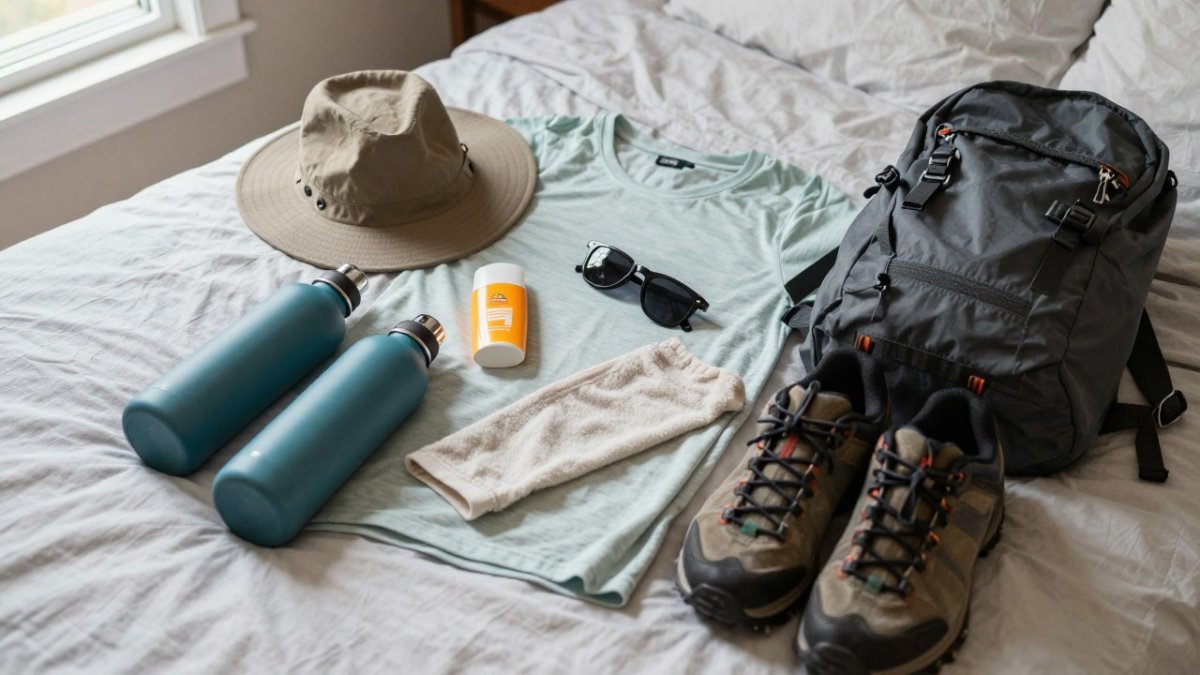
A desert trip packing list has to handle two climates in one day. Afternoons run hot, nights turn cold, and the swing catches people off guard. Pack layers, not a single outfit.
Start with these:
- Wide-brim hat and sunglasses
- Sunscreen, reapplied through the day
- Light long-sleeve shirt for sun cover
- Warm fleece or jacket for the evening
- Broken-in hiking shoes
- Two refillable water bottles per person
- Small daypack for hikes
- Headlamp or flashlight
- Basic first-aid kit
What most guides miss is the evening layer. People pack for the heat and shiver after sunset.
Heat, Water, and Emergency Planning for a Desert Weekend Getaway
Heat and water planning keeps a desert weekend getaway safe. Carry more water than feels reasonable, hike early, and know where the nearest town is. Heat illness sneaks up on people who feel fine, so the plan has to be specific enough to follow when you’re tired and hot.
Water: how much and how to ration it
Carry enough water for the length and heat of your hike, scaled up for distance and elevation gain. Carry it in more than one container so a single leak doesn’t strand you. For a car-based weekend, keep a separate jug in the vehicle that you don’t touch on the trail, that reserve is for the drive and for emergencies.
- Drink before you’re thirsty. Thirst lags behind need.
- Turn around at half your water. That’s your signal, not a suggestion.
- Ration by time, not by mood. If the plan was two hours out, two hours back, the halfway point is a hard decision, not a feeling.
Heat: timing and decision rules
- Hike before 10 a.m. and finish before the peak heat.
- Pick shade and elevation when the forecast runs hot; a higher trail can be meaningfully cooler than the valley floor.
- Watch the forecast the morning you leave and again each day. Desert weather shifts, and a hot day plus wind is worse than the number suggests.
Know the signs of heat illness and act early: dizziness, headache, nausea, confusion, or stopping sweating are reasons to get to shade, cool down, and stop the hike. Cool first, then decide whether to continue.
National Weather Service heat safety guidance
Communications and emergency supplies
Cell service drops in stretches, so plan for being out of contact:
- Tell someone your route and expected return time before you leave.
- Carry an offline map and a paper backup for the area you’re hiking.
- Know the nearest town with water, fuel, and cell service, and know which direction it is from the trailhead.
- Pack a basic emergency kit, first-aid supplies, a headlamp, a whistle, a charged power bank, and extra water.
- Check in at the trailhead where registers or ranger stations exist; it gives responders a starting point.
Watch out: a dry, hot trail with no shade is not the place to test your limits. If someone in your group is struggling, turn around together rather than splitting up.
Build the same discipline into the drive. A vehicle breakdown on an empty stretch is an emergency-planning problem as much as a mechanical one, which is why the road-trip checklist earlier in this guide pairs a full tank and a water jug with the tire and coolant checks.
Set Up Your Trip Plan With Local, Current Information
Old information is the biggest trap in desert travel. Closed trails, changed hours, and canceled events show up in outdated guides all the time. Confirm the details close to your travel date.
At Visitor Center for Palm Desert & Palm Springs, we keep our content current so you’re not planning around stale information. Before you go, check:
- Local event schedules for your weekend
- Current trail and park status
- Restaurant hours, which shift by season
- Any road or venue closures
For live updates, our guide on getting real-time local news and event updates shows where to look. And our travel planning resources pull the pieces together in one spot.
Plan the drive, pick the season, book early, and pack layers. Do those four things and your weekend takes care of itself.
Ready to lock in your stay? Visitor Center for Palm Desert & Palm Springs gives you a free, AI-powered guide to local hotels, vacation rentals, events, and attractions, all in one place. Browse current listings, check what’s happening your weekend, and build a plan that fits your drive time. Get started with Visitor Center for Palm Desert & Palm Springs and turn your desert weekend getaway into a trip that actually works.
Frequently Asked Questions
How many days do you need for a desert weekend getaway?
Two nights and two full days cover the core of a desert weekend getaway without rushing. That gives you one day for a scenic drive and short hike, one day for a town, art stops, and a long dinner, plus buffer for heat and traffic. If you are driving more than four hours each way, add a third night so the trip does not become two long drives with a short visit in between.
What should you pack for a desert weekend?
Build your desert trip packing list around temperature swings. Bring light long sleeves and a wide-brim hat for daytime, a warm layer for cool nights, closed-toe shoes with grip, more water than you think you need, sunscreen, lip balm, and a small daypack. Add a paper map or downloaded offline maps, a flashlight, and a basic first-aid kit. Keep a gallon of water and a blanket in the vehicle for emergencies.
What is the best time of year to visit the desert?
Spring and fall are the most comfortable windows for a desert weekend getaway, with mild daytime temperatures and cool nights. Winter days are cooler but popular, so book lodging and timed entry early. Summer daytime heat is intense, so plan outdoor activity for early morning and evening, carry extra water, and treat midday as indoor time. Check the forecast for your dates rather than relying on averages.
What should you check before driving in desert conditions?
Before any desert road trip planning, check tire pressure and tread, coolant, oil, and the spare. Confirm your route has fuel stops and cell coverage gaps, and download offline maps. Carry at least one gallon of water per person, a sunshade, and a blanket. Check road conditions and park alerts the morning you leave, and tell someone your route and expected arrival time.