Visitor Center for Palm Desert & Palm Springs

Desert Spa Month in September

The Ultimate Guide to Greater Palm Springs Spa Month

September typically signals the bittersweet end of summer across the country. However, it marks the arrival of the year’s most anticipated wellness event in the heart of Southern California’s Coachella Valley. Welcome to the ultimate guide to Greater Palm Springs Spa Month. It’s a month-long celebration running every year from September 1 through September 30 in honor of National Self-Care Month. Imagine trading the lingering late-summer heat for the cool, eucalyptus-scented sanctuary of a world-class wellness retreat. During this exclusive 30-day window, the region’s nine distinct cities—from the bustling downtown energy of Palm Springs to the ultra-luxurious enclaves of Indian Wells, La Quinta, and the mineral-rich aquifers of Desert Hot Springs—transform into an accessible wellness paradise. The area’s most prestigious luxury resort spas, boutique day spas, and historic hot spring bathhouses open their doors, offering exclusive discounted packages, bespoke signature treatments, and highly sought-after resort day passes that are normally priced well out of reach. For wellness seekers, this is the ultimate opportunity to bridge the gap between high-end pampering and everyday accessibility. Greater Palm Springs Spa Month offers an insider’s pass to experience the profound benefits of ancient geothermal mineral waters, cutting-edge therapies, and five-star resort amenities at a fraction of peak-season costs—inviting both locals and visitors to slow down, recharge, and invest deeply in their well-being. What Makes Spa Month So Special? What sets Greater Palm Springs Spa Month apart isn’t just a slight price markdown—it is the rare, complete unlatching of the gates to one of North America’s most elite wellness destinations. During peak winter and spring seasons, the Coachella Valley’s premier sanctuaries cater almost exclusively to jet-setting hotel guests, with treatment menus commanding steep, five-star prices and day access strictly limited. In September, that dynamic completely flips, democratizing high-end desert luxury for everyday travelers, drive-market visitors, and valley locals alike. Unrivaled Value on World-Class Treatments: Luxury resort menus that usually feature $250+ service price tags shift into promotional tiers ($99 to $160). These aren’t stripped-down express offerings; they are full 50-to-80-minute signature massages, advanced hydrafacials, and deep-tissue body polishes designed to deliver complete physical restoration. The “All-Access” Resort Privilege: Perhaps the most compelling secret of Spa Month is that booking a single discounted treatment or day pass serves as an all-access key. You trade a modest entry price for a full day of five-star resort living—lounging alongside sparkling saltwater pools, unspooling in eucalyptus steam rooms, clearing your lungs in dry saunas, and soaking in private co-ed hydrotherapy whirlpools under the desert palms. Locally Sourced Desert Botanicals: Spas lean into regional terroir during September, curating bespoke treatment menus infused with natural desert remedies. Think body scrubs crafted from crushed Medjool dates, aromatic body wraps using wild desert sage and sweet citrus, and deeply detoxifying masks mixed with local volcanic clay—allowing your skin to absorb the native, healing remedies of the valley floor. Why People Go People visit Greater Palm Springs during Spa Month because the region has been famous for rest and renewal for nearly a century. Long before modern resorts existed, people traveled to the Coachella Valley to soak in its natural, warm mineral spring water. Today, that same peaceful desert setting draws visitors who want to unplug from busy routines and recharge their energy. Furthermore, September brings a quiet, laid-back vibe to the valley. Unlike the busy winter and spring seasons, the crowds are small, making it much easier to find calm, unhurried time at top-tier properties. Drive-market visitors from Los Angeles, San Diego, and Phoenix—as well as local residents—take full advantage of this peaceful window to enjoy a luxury getaway without paying high overnight hotel rates. Top Benefits of Attending Attending Spa Month delivers noticeable, positive changes for both your body and mind. It turns a simple day trip or weekend escape into a deep, healthy reset. Physical Healing and Muscle Relief Soaking in natural hot spring mineral water (found in spots like Desert Hot Springs and downtown Palm Springs) helps soothe sore muscles, relieve joint stiffness, and calm inflammation. Pairing a thermal soak with a targeted deep-tissue massage gives your body a much-needed break from physical stress. Skin Hydration and Summer Repair Late-summer heat and sun exposure can leave your skin dry and tired. Custom hydrafacials, antioxidant berry wraps, and gentle body polishes strip away dead skin cells and lock in deep moisture, leaving your skin soft, clear, and glowing. A Complete Nervous System Reset Beyond basic relaxation, Spa Month focuses heavily on mental well-being. Participating locations offer specialized therapies like floating sound baths, red-light therapy, and quiet salt lounge sessions designed to lower stress levels, clear mental clutter, and help you sleep better. Affordable Access to Luxury In addition to health perks, Spa Month offers incredible value. You get to enjoy five-star resort amenities—like sparkling saltwater pools, eucalyptus steam rooms, and private cabanas—for a small fraction of the standard price. Which Spas Are Participating? In addition to large resort properties, local boutique studios and historic bathhouses across all nine Coachella Valley cities participate in Spa Month. You can explore options ranging from famous thermal hot springs to luxury resort gardens. Spa / Resort Name Location Standout Features & Highlights The Spa at Séc-he Downtown Palm Springs Ancient hot mineral spring water, private bathhouse suites, and state-of-the-art wellness technology. Spa La Quinta La Quinta Resort & Club Quiet desert courtyards, custom botanical treatments, and outdoor garden bath rituals. Spa Esmeralda Grand Hyatt Indian Wells Co-ed outdoor spa gardens, relaxing Jacuzzis, and private cabana rentals. Azure Palm Hot Springs Desert Hot Springs Fresh mineral water soaking pools, outdoor saunas, and floating sound bath events. The Spring Resort & Spa Desert Hot Springs Natural mineral spring pools, intimate boutique atmosphere, and targeted relaxation massages. Spa Rosa Tommy Bahama Miramonte Resort Olive grove backdrop, custom body scrubs, and poolside relaxation in Indian Wells. The Ritz-Carlton Spa Rancho Mirage Cliffside desert views, holistic body treatments, and outdoor sound baths under the stars. Spa at Desert Springs JW Marriott Palm Desert A massive 38,000-square-foot facility featuring saltwater

The Ultimate Guide to Greater Palm Springs Spa Month Read More »
Coachella Valley Firebirds

Coachella Valley Firebirds: What Every Fan Needs to Know

The Coachella Valley Firebirds have rapidly transformed the Greater Palm Springs area into one of the most vibrant sports hubs in Southern California. As the primary AHL affiliate of the Seattle Kraken, this high-powered professional ice hockey franchise brought fast-paced, world-class sports entertainment to the desert when they made their debut in December 2022. Playing out of the state-of-the-art Acrisure Arena in Thousand Palms, the Firebirds captured the region’s heart almost instantly. The team set a high bar right out of the gate, securing Western Conference titles and earning back-to-back appearances in the Calder Cup Finals during their first two seasons. Whether you are a dedicated hockey fan tracking top NHL prospects or a local resident looking for premier live events in the Coachella Valley, understanding the team’s roots, culture, and game-day experience is essential for taking in a home game. Affiliation & League The Coachella Valley Firebirds operate as the top-tier primary development affiliate for the Seattle Kraken in the National Hockey League (NHL). Functioning as the 32nd franchise in the American Hockey League (AHL), the Firebirds compete directly within the Pacific Division of the AHL’s Western Conference. This affiliation serves as a direct talent pipeline to Seattle. Top draft picks, developing prospects, and depth call-ups spend their seasons in Thousand Palms refining their skills under NHL-level management before making the leap to the Pacific Northwest. The organizational alignment ensures that system plays, coaching philosophies, and player development strategies mirror those of the Kraken, creating a seamless transition whenever players are recalled to the big leagues. Venue & Location The Coachella Valley Firebirds play their home games at Acrisure Arena, a state-of-the-art multi-purpose venue with an 11,000-seat capacity designed specifically for hockey and major entertainment. Address: 75702 Varner Road, Thousand Palms, CA 92276 Geographic Placement: Positioned in Thousand Palms directly off Interstate 10 (between Cook Street and Washington Street), making it centrally accessible to fans coming from Palm Springs, Palm Desert, La Quinta, Rancho Mirage, and Indio. Training Center: Adjacent to the main arena sits the Berger Foundation Iceplex, a 36,000-square-foot facility featuring an NHL-sized rink that serves as the Firebirds’ official practice venue while offering public skating and youth hockey programs to the local community. Arena Policies (Know Before You Go) Attending a Coachella Valley Firebirds game requires a bit of pre-game planning to ensure a smooth, hassle-free entry into Acrisure Arena: Clear Bag Policy: Acrisure Arena strictly enforces a clear bag policy. Approved bags include clear plastic, vinyl, or PVC bags not exceeding $14” \times 14” \times 6”$. Small clutch purses or wallets no larger than $4.5” \times 6.5”$ are also permitted. Backpacks, large purses, and non-clear totes are prohibited. Cashless Venue: The entire facility—including concession stands, merchandise stores (the Firebirds Team Shop), and ticketing—oprates on a 100% cashless system. Acceptable payment methods include major credit/debit cards, Apple Pay, and Google Pay. Parking Passes: Parking at Acrisure Arena is dynamic and cashless. Fans are strongly encouraged to pre-purchase parking passes online through ParkWhiz prior to arrival to secure a spot and speed up lot entry. Mobile Ticketing: All game tickets are digital and managed via mobile devices. Because cellular service near the arena entrances can become congested close to puck drop, fans should download tickets to their phone’s mobile wallet before reaching the venue. Doors Open: Arena doors typically open 60 to 90 minutes prior to game time, giving fans plenty of opportunity to watch warmups, grab food, and browse team merchandise. Tickets & Schedule Navigating tickets and timing for Coachella Valley Firebirds games is straightforward whether you’re planning a single family outing or following the entire campaign: Official Ticket Outlets: Primary single-game tickets, full season memberships, and partial ticket packages are sold through Ticketmaster (the official ticketing partner of Acrisure Arena) or via the official Firebirds mobile app. Group discounts are also available for parties of 10 or more. Season Timeline: The AHL regular season runs from mid-October through mid-April, featuring a 72-game schedule (36 home games at Acrisure Arena). Playoffs (Calder Cup Playoffs) follow immediately after, extending into May and June for deep runs. Promotional & Theme Nights: The Firebirds host over a dozen popular theme nights each season, frequently featuring stadium giveaways, special jerseys, and fan activations. Highlights include: Día de los Muertos Night Teddy Bear Toss (where fans throw stuffed animals onto the ice after the team’s first goal) New Year’s Eve Game Pride Night Paws on the Ice / Military Appreciation Nights Roster & Call-ups As the top development partner for the Seattle Kraken, the Coachella Valley Firebirds roster is a fluid combination of high-ceiling NHL prospects, veteran AHL leaders, and entry-level talent. Seattle Kraken Pipeline: The primary purpose of the roster is to prepare top draft picks and emerging stars for the NHL stage. Fans in the Coachella Valley get a front-row seat to future Seattle stars before they make their major league debuts. Call-up Dynamics: Player movement between Thousand Palms and Seattle happens frequently throughout the 72-game season. Injuries, hot streaks, or tactical roster management in the NHL can result in emergency or standard call-ups, where a Firebirds player is summoned to join the Kraken on short notice. Coaching & Management: The team operates under the direction of General Manager Troy Bodie and Head Coach Derek Laxdal, who work closely with Seattle’s front office to execute identical tactical systems and maintain high-performance training standards across both organizations. Veteran Leadership: To complement young prospects, the roster features experienced AHL veterans who provide stabilizing leadership, mentorship, and depth during high-stakes Pacific Division matchups and Calder Cup Playoff runs. Mascot & Team Culture The Coachella Valley Firebirds have created a distinct, passionate hockey culture in the Southern California desert, bridging professional sports entertainment with deep local community integration: Official Mascot (“Fuego”): The heart of the team’s fan experience is Fuego, a vibrant, orange-and-red mythical desert bird. Fuego is a staple at home games at Acrisure Arena, performing on-ice skits, rallying crowds, and visiting local schools, children’s hospitals, and civic events throughout the

Coachella Valley Firebirds: What Every Fan Needs to Know Read More »

6 Hacks About Coachella Festival

The Ultimate Coachella Festival: 6 Hacks You Didn’t Know

Every spring, the quiet desert landscape of Indio, California transforms into the epicenter of global pop culture as the Coachella Valley Music and Arts Festival takes over the iconic Empire Polo Club. What started as a modest two-day indie gathering in 1999 has evolved into a bucket-list phenomenon that draws over 250,000 attendees across two consecutive three-day weekends. Navigating Coachella requires more than just showing up; it is an immersive, high-energy event where world-class musical performances, monumental art installations, and trendsetting fashion intersect. Whether you are a first-time festivalgoer researching Coachella tips for beginners or a seasoned veteran searching for what to expect at Coachella, understanding the lay of the land is essential. From tracking down the elusive lineup release to surviving the relentless desert heat, this guide breaks down everything you need to know about the music festival that sets the standard for live entertainment worldwide. What Is the Festival Really About? At its core, Coachella is much more than a three-day concert; it is a global cultural engine where live music, fine art, digital influencer trends, and fashion converge. While casual observers see viral social media posts, the actual Coachella experience is an immersive ecosystem built around four distinct pillars: Curated Curation Over Chart Dominance: Unlike festivals that rely solely on top-40 radio hits, Coachella’s identity was built on booking genre-defying acts, rare band reunions, and underground electronic producers right before they explode into mainstream stardom. It is a place where hip-hop icons, indie rockers, pop royalty, and global artists share equal footing across multiple massive stages. Large-Scale Immersive Art: The phrase “Music and Arts” in the festival’s title is not an afterthought. The grounds are dominated by towering, original Coachella art installations—from multi-story architectural sculptures to surreal, interactive light displays—that transform the desert polo fields into a temporary outdoor museum. The Desert Escape Culture: Located against the dramatic backdrop of the Santa Rosa Mountains, the setting provides a surreal sense of escapism. The environment encourages non-stop exploration, whether that means catching a secret set in the air-conditioned Yuma Tent, lounging on the polo grass at sunset, or exploring pop-up food villages featuring culinary creations from top LA chefs. A Cultural Microcosm: Ultimately, Coachella serves as an annual temperature check for pop culture. It is where visual fashion trends are tested, music history moments are made (like historic surprise guest cameos and groundbreaking headliner performances), and half a million fans gather to share a singular, collective moment. Lineup & Schedule The heartbeat of Coachella relies entirely on its roster of artists and the logistical art of timing their performances. Anticipation builds for months before the gates ever open, driving heavy online search volume around how, when, and where to catch your favorite acts. Lineup Release Timeline: Goldenvoice typically drops the official Coachella lineup in early January (or late autumn in special release cycles). Searches spike exponentially during this window as fans scrub the poster to identify the headliners, sub-headliners, and genre-specific stage takeovers. Decoding the Schedule & Set Conflicts: Detailed daily schedules and exact set times are kept secret until just a few days before Weekend 1. Once released, attendees face the inevitable “set conflicts”—where two must-see artists perform at the exact same time across different stages. Strategic planning becomes crucial to map out walking routes between the main Coachella Stage, Outdoor Theatre, Sahara Tent, and the Yuma Tent. The Official Coachella App: Essential for navigating the festival grounds, the Coachella app is the primary tool for building personalized schedules, receiving real-time push notifications about unscheduled guest appearances, and managing wristband activation. Surprise Sets & Secret Guests: Beyond the official roster, Coachella is famous for surprise cameos—from unexpected guest singers popping up during headlining sets to unannounced DJ performances in the Do LaB or Heineken House stages. Tickets & Logistics Securing passes and planning entry into the Empire Polo Club is often the most stressful part of the festival experience. High demand, strict purchasing windows, and complex transportation options mean attendees must plan months in advance. Pass Types & Cost Structure: Coachella pass pricing varies depending on tier releases and chosen inclusions: General Admission (GA): Grants access to all three days of the festival, venue grounds, and standard food/craft beverage areas. Passes generally range from $549 to $649 depending on tier level and chosen weekend. GA + Shuttle Combo: Includes standard 3-day venue access along with unlimited rides on the official Valley Shuttle system. Typically priced between $679 and $779. VIP Passes: Ranging from $1,199 to $1,399, VIP grants access to dedicated entry lanes, air-conditioned restrooms, shaded seating, and exclusive food/beverage gardens near the main stages (though it does not offer special front-of-stage viewing access). On-Sale Windows & Payment Plans: Goldenvoice runs a Coachella presale during the June prior to the festival, allowing fans to lock in passes with flexible monthly payment plans starting at $49 down. The main general sale takes place in January following the official lineup drop. Wristband Activation & Rules: Festival passes arrive as RFID-chipped wristbands in early spring. Attendees must activate their specific wristband via the official mobile app prior to arrival, as passes are non-transferable once applied to a wristband. No Single-Day Passes: A universal policy that catches first-timers off guard: Coachella single-day passes do not exist. All official ticket sales are exclusively for 3-day admission. Accommodations & Travel Finding a place to stay and securing reliable transportation around the Coachella Valley are critical factors that can make or break your festival weekend. Because over 100,000 visitors descend upon the desert each weekend, lodging and transit must be booked as far in advance as possible. On-Site Festival Camping: For many, camping is the ultimate Coachella experience, offering continuous energy and immediate proximity to the venue gates without commuting. Car Camping: The most popular and budget-friendly option. Attendees park a single vehicle in a designated 10×30 spot and pitch tents directly behind or above it. Preferred Car Camping: Guarantees a spot in the closest lots to the festival entrance, regardless of what

The Ultimate Coachella Festival: 6 Hacks You Didn’t Know Read More »

The Queen Mary

The Queen Mary: A retired British Oceanliner Hotel and Tours – 120 MILES FROM PALM DESERT

Before the era of jetliners, crossing the North Atlantic was a ritual of pure prestige. Built by John Brown & Company, the RMS Queen Mary made her grand debut in 1936, ruling the waves alongside her sister ship, the Queen Elizabeth. Crafted to outshine the fierce competition from German, Italian, and French superliners, this Scottish-built Titan was the crown jewel of Cunard-White Star Line’s weekly express service between Southampton, Cherbourg, and New York. Today, permanently docked in Long Beach, California, she stands as a living museum and time capsule of maritime royalty. Step Inside an Art Deco Masterpiece Stepping aboard the Queen Mary isn’t just checking into a hotel—it’s stepping into a living canvas of 1930s glamour. Her staterooms retain their soul: warm, polished wood paneling, original mid-century artwork, vintage fixtures, and actual working portholes that frame views of the harbor. Rather than uniform modern hotel rooms, each space carries a distinct personality from the golden age of ocean travel. Living History Onboard Following an extensive restoration by the City of Long Beach, the ship’s legendary corridors are buzzing with life again. Guests and history buffs can explore iconic spaces on guided docent tours: The Observation Bar: Sip in the classic elegance of an authentic 1930s cocktail lounge. The Grand Salons: Walk through the sweeping Royal and Queen Salons, where world leaders, movie stars, and royalty once mingled. The Promenade Deck: Stroll the deck for panoramic coastal views while docents share whispers of the ship’s famous haunted lore. Heritage Hall: Catch a glimpse of the massive engineering feats behind her preservation through interactive displays and films. Frequently Asked Questions Can I book a tour in advance? Due to high demand, reservation policies fluctuate. Check the official website before heading out to lock in current availability. Are pets allowed on board? Only certified service animals are permitted on the ship, though nearby Long Beach offers several pet-friendly lodging options. Can I take photos during my visit? Absolutely. Personal photography is encouraged throughout the public decks and grand halls. Commercial shoots, however, require advance permits. Are there places to eat on the ship? Yes, choices range from casual deckside bites to upscale fine dining surrounded by authentic Art Deco woodwork. Can I host a wedding or private event on the ship? Yes, the Queen Mary offers several historic ballrooms and outdoor decks for custom events and weddings. Ready to walk the decks of history? Reserve Your Room.

The Queen Mary: A retired British Oceanliner Hotel and Tours – 120 MILES FROM PALM DESERT Read More »

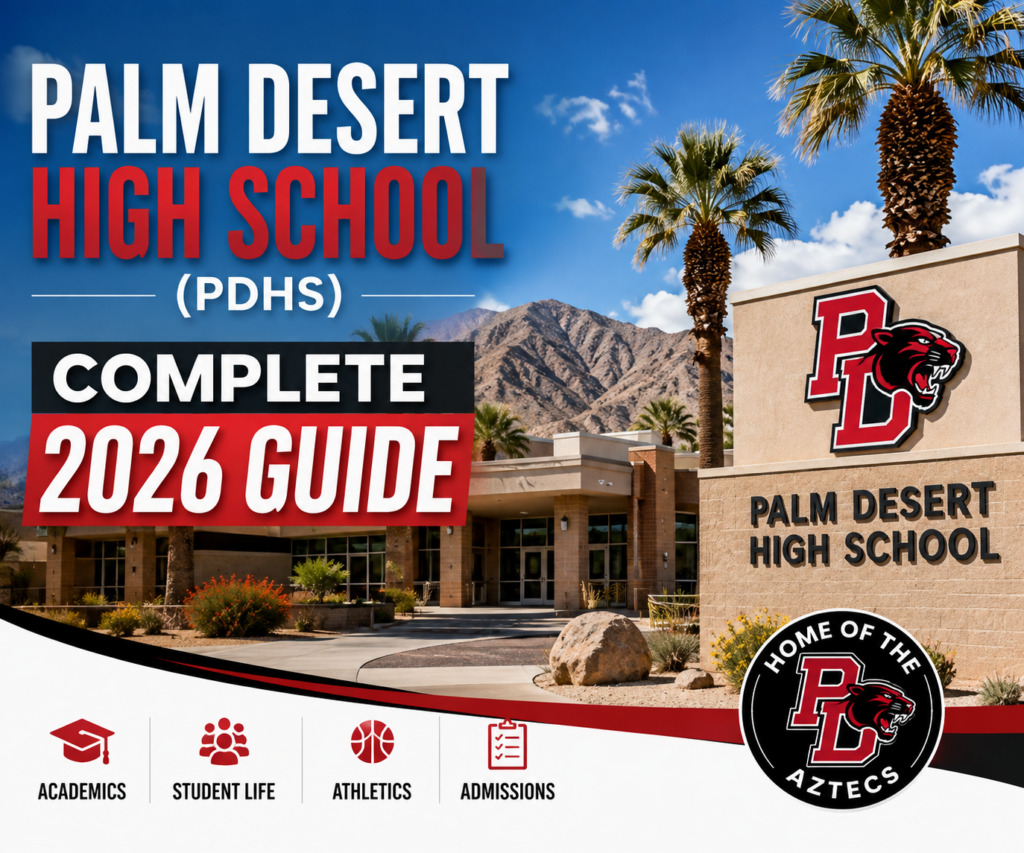
Palm Desert High School (PDHS)

Palm Desert High School (PDHS) Complete 2026 Guide

Palm Desert High School (PDHS) is situated in the central heart of Palm Desert, California, within the Coachella Valley. It sits just south of the main commercial corridors of the desert, placing it close to residential neighborhoods, higher education campuses, and primary transit routes. Street Address & Geographic Coordinates Address: 74910 Aztec Road, Palm Desert, CA 92260 Cross Streets: Located just east of Cook Street and south of Fred Waring Drive, two of the Coachella Valley’s primary thoroughfares. Neighborhood Context & Surroundings Educational Hub: PDHS is located just south of the College of the Desert (COD) main campus and the CSU San Bernardino Palm Desert Campus, creating an educational corridor along Cook Street that makes dual-enrollment opportunities physically accessible for upperclassmen. Civic & Cultural Amenities: The campus is minutes away from civic facilities, including the Palm Desert Civic Center Park, the Palm Desert City Library, and the McCallum Theatre. Residential Setting: The surrounding area consists primarily of single-family residential subdivisions, gated communities, and local parks, making it central for students commuting from Palm Desert, Rancho Mirage, and northern Indian Wells. Campus Accessibility & Commute Traffic Patterns: Because Cook Street and Fred Waring Drive serve as major arterial roads for the entire mid-valley, drop-off and pick-up hours bring significant traffic density around Aztec Road and Hovley Lane. Public Transit: The SunLine Transit Agency services the nearby arterial corridors, connecting the campus directly with surrounding desert cities. Modern Campus Rebuild The physical campus underwent a complete, multi-million-dollar modernization and reconstruction project. The original 1986 facilities were replaced with updated, state-of-the-art classroom buildings, upgraded athletic complexes, a modernized library, and a large multi-purpose gymnasium designed to support the school’s large student population. Academic quality and performance Palm Desert High School (PDHS) maintains a reputation as one of the flagship academic institutions within the Desert Sands Unified School District (DSUSD) and across the greater Coachella Valley. Key Academic Metrics & Recognition State & National Rankings: PDHS consistently ranks among the top public high schools in Riverside County and the upper tier of California high schools in publications such as U.S. News & World Report and Niche. California Distinguished School: The campus has earned designation as a California Distinguished School and a California Gold Ribbon School, reflecting strong standardized testing outcomes, high graduation rates, and closed achievement gaps. Graduation Rate & College Readiness: The school maintains a graduation rate well above 95%, with a high proportion of graduates completing the California State University (CSU) and University of California (UC) “A-G” subject requirements necessary for four-year university admission. Advanced Placement (AP) & Rigor PDHS offers a robust college-preparatory curriculum featuring more than 30 Advanced Placement courses spanning STEM, humanities, languages, and fine arts. AP Capstone Diploma Program: PDHS is an authorized AP Capstone school, allowing students to take AP Seminar and AP Research. Students who score 3 or higher on both courses, plus four additional AP exams, earn the AP Capstone Diploma—a distinction valued by university admissions committees. High Exam Participation: A large segment of the student body participates in AP coursework, with exam pass rates historically exceeding both state and national averages. Dual Enrollment & College Pathways Capitalizing on its proximity to local higher education institutions, PDHS offers articulated college-level coursework directly to high school students: College of the Desert (COD) Dual Enrollment: Through partnerships with COD, students can take transferable college-level courses on the PDHS campus or online, earning both high school credits and college credits tuition-free. CSU & UC Alignment: Academic counseling emphasizes early pathway tracking to ensure students meet UC/CSU eligibility requirements by their senior year. CTE Academies & Specialized Pathways Beyond standard college prep, PDHS integrates Career Technical Education (CTE) pathways that bridge academic theory with industry skills: Pathway / Academy Focus Areas Key Outcomes Health Academy / Medical Industry Medical terminology, anatomy, sports medicine, healthcare ethics Hands-on lab work and preparation for post-secondary healthcare degrees Engineering & Architecture Drafting, CAD design, robotics, structural engineering fundamentals Project-based learning aligned with STEM university majors Digital Arts & Media Production Broadcast journalism (Aztec TV), graphic design, digital film production Real-world studio operation and portfolio development Programs at Palm Desert High School Palm Desert High School (PDHS) offers a comprehensive array of specialized academic pathways, technical academies, and extracurricular programs designed to prepare students for both four-year universities and direct entry into competitive career sectors. Special Academic Pathways & Academies PDHS structures several of its career-focused programs around California Partnership Academies and Career Technical Education (CTE) multi-year sequences: Health Careers Academy: A structured three-year cohort program (“school-within-a-school”) focused on patient care, medical technology, and sports medicine. Using Project Lead The Way (PLTW) biomedical curriculum, upperclassmen gain clinical skills, medical terminology, and complete internships with local healthcare providers and medical offices. Engineering Pathway: Grounded in PLTW STEM standards, this pathway covers mechanical and structural engineering, CAD drafting, digital electronics, and robotics. Courses meet UC/CSU laboratory science requirements and emphasize hands-on design challenges. AVID (Advancement Via Individual Determination): Designed to support first-generation college-bound students, AVID provides structured tutorial sessions, organizational skills training, college visits, and assistance with financial aid applications throughout all four years. Aztec Arts Academy & Visual/Media Arts PDHS houses a prominent visual and performing arts department, organized under the Aztec Arts Academy banner: Branch / Pathway Core Focus Key Student Outputs Film & Broadcasting Digital cinematography, audio production, and broadcast journalism. Producing Aztec TV (the daily student broadcast) and student film portfolios. Theatre Arts Acting, stagecraft, set construction, lighting, and sound direction. Mainstage seasonal theatrical productions and competitive drama showcases. Dance & Performing Arts Technical training across jazz, hip-hop, contemporary, and ballet choreography. Seasonal dance concerts and performances at school-wide events. Instrumental & Vocal Music Marching band, jazz ensemble, orchestra, and concert choir. Halftime shows, regional festival evaluations, and community performances. Military Science & Cadet Corps California Cadet Corps (CACC): Operated through the National Guard, this program provides leadership development, military drill and ceremonies, physical fitness training, and citizenship education. Students earn elective or physical education credits while advancing in cadet rank.

Palm Desert High School (PDHS) Complete 2026 Guide Read More »

Scroll to Top