
Last Updated: October 22, 2026
Quick Summary
Yes, is palm desert safe for family travel, the overwhelming majority of visiting families have safe, enjoyable trips. Focus your planning on heat safety, sun protection, and hydration rather than crime, stay in resort and gated corridors, lock your car and room, and you’ll have as safe an experience as any comparable desert destination.
- Vehicle break-ins are the most common visitor crime; keep bags and electronics out of sight and locked in your room safe, not the trunk.
- Heat illness, sunburn, and dehydration pose greater risk than crime; bring twice as much water as you think you’ll need and reapply sunscreen every two hours.
- February offers ideal family travel weather with daytime temperatures of 70°F to 85°F; summer visits above 110°F require early morning or evening outdoor activities only.
- Resort pools require constant parental supervision within arm’s reach for young children; ask staff about depth markers, lifeguard hours, and safety barriers during check-in.
- Save 911, Poison Control (1-800-222-1222), and the nearest hospital address in your phone before arrival; ask the front desk for the closest urgent care with evening hours.
Table of Contents
- Is Palm Desert Safe for Family Travel? What You Need to Know
- Palm Desert Safety for Tourists: Crime, Neighborhoods, and Visitor Precautions
- Palm Desert Weather and Heat Safety: Desert Climate Challenges by Season
- Getting Around Palm Desert with Children: Transportation and Road Safety
- Kid-Friendly Accommodations and Resort Safety
- Family-Friendly Activities and Age-Appropriate Attractions
- Emergency Planning and Healthcare Access for Families
- Pool and Resort Safety for Young Children
- Planning Your Safe Family Vacation to Palm Desert
- Frequently Asked Questions
Is Palm Desert Safe for Family Travel? What You Need to Know
Safety is a legitimate concern for any family vacation, but Palm Desert is welcoming, and smart planning makes the difference between a relaxed getaway and unnecessary stress.
At the Visitor Center for Palm Desert & Palm Springs, we help families navigate the Coachella Valley with confidence. This guide covers is palm desert safe for family travel, from neighborhood awareness to heat precautions to emergency resources.
Palm Desert is generally safe for families, especially in tourist and resort areas. The key is understanding local conditions, seasonal weather risks, and smart precautions that apply to any desert destination.
Palm Desert Safety for Tourists: Crime, Neighborhoods, and Visitor Precautions
Is Palm Desert safe for family travel? For the overwhelming majority of visiting families, yes, but the honest answer separates three things travelers blur together: citywide crime statistics, visitor-zone conditions, and everyday vacation risks.
What the official data does and does not tell you
Palm Desert is a small city, roughly 50,000 residents, inside the larger Coachella Valley. The most reliable local crime sources are the FBI’s Uniform Crime Reporting program and the California Department of Justice’s OpenJustice portal, both publishing annual city-level figures. The Palm Desert station of the Riverside County Sheriff’s Department handles local law enforcement.
A few framing points matter more than any single number:
- City-level rates describe residents, not visitors. A citywide property-crime rate does not translate into per-trip risk for a family in a resort corridor.
- Property crime dominates the totals. The practical takeaway is theft prevention, not personal-safety fear.
- Tourist zones are patrolled differently. Resort corridors along Highway 111, El Paseo, and major gated communities layer private security on public patrol.
- Seasonality shifts the picture. In peak season (roughly January through April), traffic, parking congestion, and opportunistic theft rise; violent crime does not spike the same way.
FBI Crime Data Explorer and California OpenJustice crime data are the two sources worth checking before you book if current numbers matter to you.
Neighborhood and area guidance for families
Rather than treating the whole city as one safety environment, think in zones:
- Resort and gated-community corridors (Highway 111, Country Club Drive, the major golf resorts): Well-lit, well-patrolled, and designed around visitor traffic, where most families stay and the fewest visitor incidents occur.
- El Paseo and downtown retail districts: Busy, walkable, and family-friendly by day and early evening. After restaurant closing time the mix shifts toward bar traffic; families with young children are more comfortable heading back by then.
- Established residential neighborhoods: Quiet and safe to walk, but with fewer sidewalks and less lighting, fine for a morning stroll, less ideal for a late-night walk with a stroller.
- Highway 111 and I-10 frontage roads: The main hazard is traffic and merging, not crime.
- Trailheads and open desert edges: Heat, navigation, and cell coverage matter far more than crime.
Visitor precautions that actually matter
- Vehicle break-ins are the single most common visitor crime. Keep bags, electronics, and shopping bags out of sight, especially at trailheads and outlet lots. Lock valuables in the room safe, not the trunk.
- Keep resort room doors and patio sliders locked, including ground-floor units with pool access.
- Walk in pairs or groups after dark on lit, populated routes.
- Use ride-share or hotel shuttles for evening dinners if you plan to drink; DUI enforcement is active and checkpoints are common in peak season.
- Ask the front desk which entrances and parking areas they recommend after dark.
If you are choosing between two otherwise similar properties, ask each one two questions: whether parking is gated or patrolled overnight, and whether the property has a designated family pool with posted depth markers and a safety barrier. The answers tell you more about day-to-day family safety than any crime statistic.
The risks that actually send families to urgent care
The honest ranking of family risk in Palm Desert is not crime, it is heat illness, sunburn, dehydration, pool incidents, and minor traffic collisions on fast arterial roads. Plan for those five, apply ordinary city awareness, and your family is as safe here as in any comparable resort destination.
Palm Desert is a low-drama destination for families. Read official crime data for context, stay in the resort and gated corridors, lock your car and patio door, and spend your real planning energy on heat, water, and pool supervision, those are the risks that actually affect visiting families.
Palm Desert Weather and Heat Safety: Desert Climate Challenges by Season
Desert heat is real, the biggest safety concern for families visiting Palm Desert, ahead of crime and traffic.
Temperatures vary dramatically by season. Winter (November through March) brings mild, comfortable weather; summer (June through August) brings extreme heat above 110°F; spring and fall are moderate transitions.
February is peak season for family travel, with daytime temperatures of 70°F to 85°F and nights cooling to 50°F to 60°F, ideal for hiking without heat stress.
Summer visits require careful planning. Schedule outdoor activities for early morning or evening; midday sun risks heat exhaustion and dehydration, especially for young children and older adults.
Sun Exposure and Hydration in the Desert
Desert sun is intense, and dry air makes sweat evaporate quickly, people don’t realize how fast dehydration happens.
Protect your family with these steps:
- Apply sunscreen every two hours (SPF 30 minimum)
- Wear lightweight, light-colored clothing that covers skin
- Use wide-brimmed hats for all family members
- Bring more water than you think you’ll need and drink constantly, not just when thirsty
- Take shade breaks every 30 to 45 minutes during outdoor activities
Children’s skin is more sensitive. Babies under six months should avoid direct sun entirely; toddlers and young children need extra protection and frequent water breaks.
Watch for dehydration signs: dark urine, dizziness, headache, irritability, or lethargy. If anyone shows them, move to shade immediately and drink water.
Book Hotels with Exclusive Discounted Rates HERE →
Seasonal Temperature Variations and February Travel
February is the sweet spot for family travel to Palm Desert: comfortable temperatures, low humidity, minimal rainfall, and outdoor activities that feel pleasant rather than exhausting. March and April warm up but remain manageable; by June, temperatures regularly climb above 100°F.
If you’re visiting outside the ideal window, plan accordingly:
- November to January: Cool mornings and evenings; perfect for hiking and outdoor exploration
- February to March: Peak season; mild temperatures; busy resorts and attractions
- April to May: Warming trend; still manageable for active families; fewer crowds
- June to August: Extreme heat; limit outdoor time to early morning and evening; prioritize indoor attractions
- September to October: Heat lingers; gradual cooling begins; fewer tourists
Getting Around Palm Desert with Children: Transportation and Road Safety
Desert roads are generally well-maintained, but driving requires attention, especially with children in the car.
Most families rent a car. Roads to major attractions like Joshua Tree National Park are straightforward, traffic is moderate compared to major cities, and parking is abundant and free at most attractions.
Safety tips for driving with kids:
- Use proper car seats for children under 8 or under 57 inches tall
- Keep children in rear seats (safest position)
- Never leave children unattended in vehicles
- Avoid driving during peak heat hours if possible
- Check tire pressure and fluid levels
- Stay hydrated while driving; dehydration affects focus
Desert driving has quirks. Dust storms can reduce visibility suddenly, pull over safely and wait. Don’t drive through flooded washes; water depth is deceptive.
Most attractions are within 30 to 45 minutes of central Palm Desert. Joshua Tree National Park is about 45 minutes away; Idyllwild, a cooler mountain town, is 90 minutes north.
Never leave children or pets in a parked car, even briefly. Interior temperatures can exceed 130°F in minutes. This is a serious safety hazard that happens quickly in desert heat.
Kid-Friendly Accommodations and Resort Safety
Where you stay matters, safe, family-oriented accommodations make a huge difference.
The Visitor Center for Palm Desert & Palm Springs can help you find options that match your family’s needs. Browse our directory of Palm Desert hotels and resorts for properties with family amenities, pools, and security features. If you prefer more space and privacy, Palm Desert vacation rental homes offer another option, many with private pools, full kitchens, and separate living areas.
What to look for in family accommodations:
- Gated or secure entry
- Well-lit parking areas
- 24-hour front desk staff
- Pools with lifeguards or safety barriers
- Room safes for valuables
- On-site dining or nearby restaurants
- Ground-floor rooms (easier with strollers and luggage)
- Cribs and high chairs available
Resort staff are trained to assist families, and many offer kids’ clubs, activities, and babysitting services. Ask about safety features when booking, good properties are transparent about security measures.
Family-Friendly Activities and Age-Appropriate Attractions
Palm Desert offers activities for every age. Match options to your family’s comfort level and energy. Young children (ages 2-5) enjoy resort pools with shallow areas, short nature walks under 1 mile, visitor centers with interactive exhibits, playgrounds, and indoor attractions during peak heat. School-age children (ages 6-11) can handle moderate 2-3 mile hikes on maintained trails, gondola rides, rock formations, supervised outdoor adventure activities, and biking on flat, paved paths. Teens (ages 12+) enjoy longer hikes with elevation gain, rock climbing or rappelling, desert photography, outdoor sports, and challenge courses.
Short Hikes and Nature Exploration for Different Ages
Desert landscapes are stunning, and hiking is a highlight for many families, but it requires planning.
Choose trails based on age and fitness:
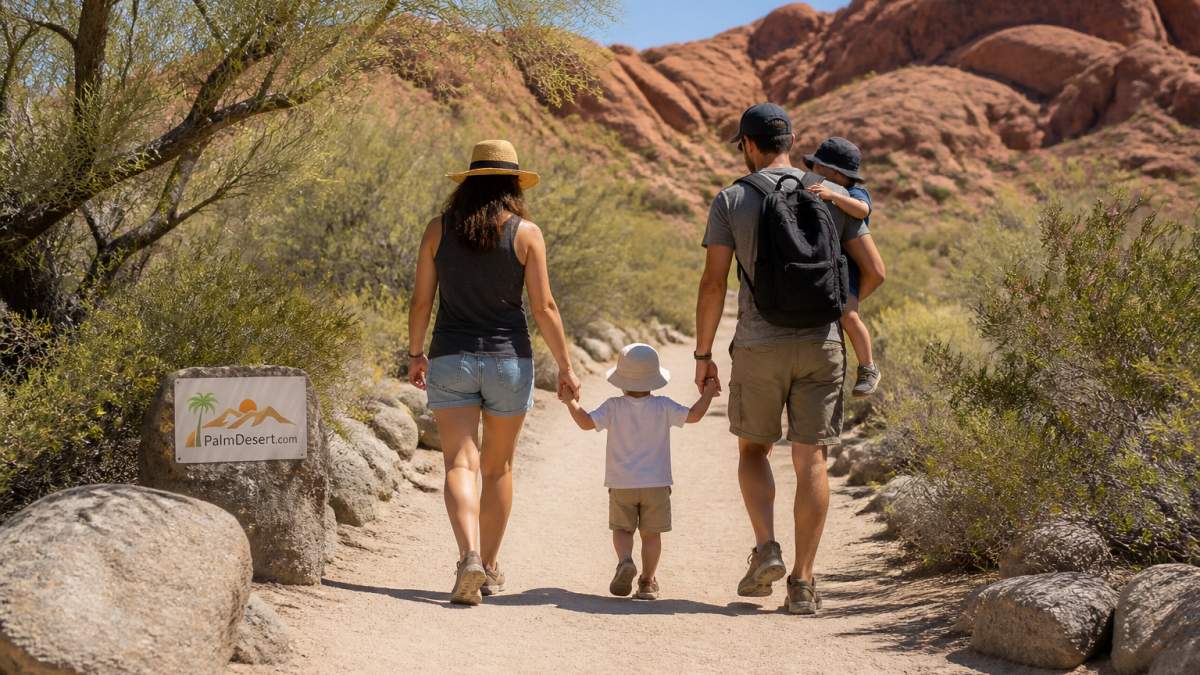
- Toddlers and preschoolers: Paved paths, 0.5-mile loops, shade available
- Early elementary: Well-maintained trails, 1-2 miles, some elevation change
- Older elementary: Moderate trails, 2-4 miles, varied terrain
- Teens and adults: Challenging trails, 4+ miles, significant elevation
Start early to avoid midday heat, bring plenty of water, and wear proper footwear, desert terrain is rocky and uneven. Rattlesnakes are present but rarely encountered on maintained trails. Popular family-friendly options include Moorten Botanical Garden trails (easy, shaded, educational), Desert Discovery Trail at visitor centers (paved, short, interpretive), Tahquitz Canyon trails (moderate, waterfall views), and Barker Dam trail in Joshua Tree (moderate, historic interest).
Day Trips to Joshua Tree and Regional Attractions
Joshua Tree National Park is a must-see, 45 minutes from central Palm Desert and spanning 1,200 square miles of dramatic desert landscape. Family-friendly activities include scenic drives with pullouts, short nature walks and interpretive trails, rock formations and climbing areas, visitor center exhibits and ranger programs, and sunset viewing. Plan a half-day or full-day visit: start early to beat crowds and heat, and bring sunscreen, water, and snacks, the park has limited services.
Other regional attractions:
- Palm Springs Aerial Tramway (gondola ride with mountain views)
- Living Desert Zoo and Gardens (interactive wildlife experience)
- Coachella Valley Preserve (rare oasis, hiking trails)
- Indian Canyons (waterfall hikes, cultural significance)
- Downtown Palm Springs (shopping, dining, galleries)
The Visitor Center for Palm Desert & Palm Springs provides information on desert attractions and day trips throughout the region.
Emergency Planning and Healthcare Access for Families
Emergencies are rare on a family trip, but the desert adds a few scenarios that reward five minutes of preparation.
Book Hotels with Exclusive Discounted Rates HERE →
Who to call and where to go
- 911 for any life-threatening emergency, heat stroke, drowning, a serious fall on a trail, a vehicle collision. Dispatchers route to the Riverside County Sheriff’s Department and to the nearest fire and EMS agency.
- 988 for the Suicide & Crisis Lifeline, if a family member is in mental-health crisis during the trip.
- Poison Control: 1-800-222-1222, free and available 24/7, for suspected ingestion of desert plants, pool chemicals, or medications.
- Non-emergency sheriff line for property crime reports, lost items, and noise complaints, ask the front desk for the current number, since it changes.
For care, the Coachella Valley has a full range of options:
- Hospital emergency departments in the Palm Desert-Rancho Mirage-Indio corridor handle serious illness and injury. Eisenhower Health in Rancho Mirage is the valley’s largest hospital system and the usual referral point for serious cases.
- Urgent care clinics along Highway 111 are right for sprains, minor infections, ear pain, rashes, and mild dehydration, faster and far less expensive than an ER for non-emergencies.
- Retail pharmacy clinics (CVS MinuteClinic, Walgreens) handle strep tests, ear infections, and basic prescriptions, often walk-in.
- Pediatric care: for an infant or young child, call ahead to confirm the facility treats pediatric patients.
CDC Travelers’ Health is the standard reference for pre-trip vaccinations and destination health notices.
Desert-specific incidents and what to do first
Heat stroke (different from heat exhaustion). Heat exhaustion, heavy sweating, weakness, nausea, headache, calls for shade, fluids, and cooling.
Dehydration in children. Watch for dark urine, no urine for several hours, sunken eyes, lethargy, or unusual irritability. Oral rehydration solution beats water alone for significant fluid loss; pharmacies stock it.
Snakebite. Rattlesnakes are present but rarely encountered on maintained trails and almost never inside resorts.
Flash floods. Desert washes can flood from rain that fell miles away. Never drive or walk through flowing water in a wash or low crossing; depth and current are deceptive.
Pool incidents. If a child is missing near water, check the pool first, drowning is silent.
Pre-trip checklist that earns its keep
- Save 911, Poison Control, your insurance’s nurse line, and the nearest hospital address in every adult’s phone before you leave.
- Download offline maps for the valley and any park you plan to visit; cell coverage is reliable in town and spotty on trails and in the national park.
- Carry a small first-aid kit with blister care, tweezers, oral rehydration packets, and children’s fever reducer.
- Bring copies of prescriptions, allergy lists, and insurance cards, a photo on each phone is enough.
- Confirm whether your insurance covers out-of-network care in the valley, or buy short-term travel medical coverage if it does not.
- Tell one person at home your itinerary for any hike or day trip outside town.
Heat stroke is the one desert emergency where minutes matter most. If a family member becomes confused, stops sweating in extreme heat, or faints, call 911 immediately and start cooling, do not wait to see if they feel better.
Ask the front desk at check-in for two pieces of information: the nearest urgent care with evening hours, and the nearest emergency department. Write both on a note in your room. In an actual emergency, you will not want to be searching on your phone.
Pool and Resort Safety for Young Children
Pools are a highlight for families, and a responsibility.
Resort pools are typically supervised and well-maintained, with lifeguards during peak hours and standard depth markers and safety barriers. But they require constant parental attention:
- Never leave children unattended near water
- Use properly fitted life jackets for weak swimmers (not floaties)
- Teach water safety basics before swimming
- Know CPR (many resorts offer classes)
- Establish clear pool rules with your children
- Watch for signs of distress: struggling, silent drowning, unusual behavior
Younger children need constant adult supervision within arm’s reach, shallow areas for practice, and a gradual introduction to deeper water. Ask resort staff about pool depth, temperature, and safety features during check-in.
Planning Your Safe Family Vacation to Palm Desert
Safety planning makes family travel smoother and more enjoyable, mostly common sense applied to desert conditions.
Start with these steps:
- Choose accommodations in established resort or vacation rental communities
- Check weather forecasts and pack accordingly
- Plan outdoor activities for cooler times (early morning or evening)
- Bring more water and sunscreen than you think you’ll need
- Identify nearby medical facilities and emergency contacts
- Arrange transportation (rental car or ride service)
- Build in rest time, especially for young children
- Research activities appropriate for your family’s ages and fitness levels
The Visitor Center for Palm Desert & Palm Springs is here to help with current information on accommodations, attractions, events, and travel planning.
| Planning Element | Why It Matters | Action to Take |
|---|---|---|
| Accommodation choice | Sets tone for entire stay; affects safety and comfort | Book in established resort or gated rental community |
| Weather awareness | Determines activity timing and what to pack | Check forecast; plan outdoor time for cooler hours |
| Hydration planning | Prevents heat-related illness, especially for kids | Bring twice as much water as you think you’ll need |
| Activity selection | Ensures activities match family’s age and fitness | Choose age-appropriate options; start with easier activities |
| Emergency prep | Provides peace of mind and faster response if needed | Know hospital location; save emergency contacts |
| Sun protection | Prevents sunburn and heat exhaustion | Pack sunscreen; reapply every two hours |
Planning a family trip to the Coachella Valley? Safety and preparation make all the difference. Explore our curated selection of Palm Desert hotels and resorts and vacation rental homes to find the perfect base, then check our desert attractions guide and desert adventure options to plan activities for every age. The Visitor Center for Palm Desert & Palm Springs team is ready to help you create a safe, memorable family vacation.
Frequently Asked Questions
Is Palm Desert safe for families with young children?
Yes, Palm Desert is generally safe for families with young children. The area has low violent crime rates and family-friendly neighborhoods. Key precautions include supervising children near pools and bodies of water, protecting against intense sun exposure, staying hydrated in the desert heat, and using car seats for young children. Most resorts and hotels offer family amenities and safety features designed for children. Planning ahead for the desert environment and choosing accommodations with good safety records ensures a secure family vacation.
What are the main safety concerns for families visiting Palm Desert?
The primary concerns are heat-related illness, sun exposure, and dehydration rather than crime. Desert temperatures can exceed 110°F in summer months. Families should limit outdoor activities during peak heat hours, apply high-SPF sunscreen, drink water constantly, and watch for heat exhaustion symptoms in children. Road safety is important when driving to attractions like Joshua Tree. Pool safety requires constant supervision of young children. Choosing accommodations with reliable air conditioning and medical facilities nearby reduces risk significantly.
Do families need a car to get around Palm Desert with children?
Yes, a car is essential for families visiting Palm Desert. Public transportation is limited, and most family attractions, dining, and accommodations are spread across the valley. A rental car provides flexibility for day trips to Joshua Tree, access to kid-friendly restaurants, and the ability to reach emergency services quickly if needed. Ensure your vehicle is well-maintained for desert driving, keep an emergency kit in the car, and plan routes in advance. Many families find having their own transportation reduces stress and increases safety.
What should families know about staying safe in the desert heat?
Desert heat requires active management. Stay indoors or in shade during peak hours (11 a.m. to 4 p.m.), drink water even if not thirsty, and never rely on thirst as a hydration indicator for children. Dress in light, loose clothing and wide-brimmed hats. Apply sunscreen with SPF 30 or higher every two hours. Watch children for heat exhaustion signs including excessive sweating, weakness, or dizziness. Plan outdoor activities for early morning or late afternoon. Choose accommodations with pools and air conditioning. February offers milder temperatures ideal for families, while summer months require extra precautions.

