Table of Contents
- What Makes a Golf Course Community Stand Out
- Palm Desert Golf Course Homes for Sale and Community Options
- Golf Community Amenities in Palm Desert Beyond the Course
- Palm Desert Golf Course Access for Residents and Members
- Choosing the Right Golf Course Community for Your Lifestyle
- Comparing Communities Side-by-Side
- What to Know Before Buying in a Golf Course Community
- Frequently Asked Questions
Last Updated: October 8, 2026
What Makes a Golf Course Community Stand Out
A golf course community combines residential living with private or semi-private golf access.
Three factors matter most when evaluating golf course communities: course quality and design, amenities beyond golf, and lifestyle fit. The course is the centerpiece, but the clubhouse, dining, fitness facilities, and social calendar determine year-round engagement.
The course sets the tone: championship designs attract serious players, par-3 executive courses suit lower-stakes rounds, and public access draws broader demographics.
Palm Desert Golf Course Homes for Sale and Community Options
Palm Desert‘s golf communities are not interchangeable, each was built in a different era, around a different course, for a different buyer. Compare them on course designer, home style, and who the community suits.
The Established Clubs
Bighorn Golf Club sits in south Palm Desert against the Santa Rosa Mountains, built around two private Tom Fazio courses: the Mountains and Canyons.
Ironwood Country Club is a long-established south Palm Desert club with two 18-hole private courses, the North and South, designed by Desmond Muirhead.
Indian Wells Country Club, just west of Palm Desert, is the valley’s original country club, founded in the mid-1950s.
The Daily-Fee and Semi-Private Side
Not every golf community is built around a private club.
Desert Willow Golf Resort operates the city-owned Firecliff and Mountain View courses, both designed by Michael Hurdzan and Dana Fry.
Marriott’s Shadow Ridge anchors a large north Palm Desert residential area around a Nick Faldo-designed course, with villas, townhomes, and single-family homes.
PGA West in La Quinta, a short drive east, is the valley’s best-known golf address, with multiple courses including the Pete Dye-designed TPC Stadium Course.
How the Communities Compare
| Community | Courses / Designer | Typical Home Types | Buyer Fit |
|---|---|---|---|
| Bighorn Golf Club | 2 private, Tom Fazio | Custom estates, villas | Ultra-luxury, privacy |
| Ironwood Country Club | 2 private, Desmond Muirhead | Detached homes, condos, patio homes | Traditional club, varied budgets |
| Indian Wells Country Club | 3 courses, Ted Robinson | Resale homes to renovated estates | History, tournament tradition |
| The Vintage Club | 2 private, Tom Fazio | Large estate homes | Low-density, quiet luxury |
| Desert Willow area | 2 daily-fee, Hurdzan/Fry | Single-family, some condos | Public access, no initiation |
| Shadow Ridge | 1 resort course, Nick Faldo | Villas, townhomes, single-family | Resort living, rental potential |
Location Within the Valley
Location changes daily life more than most buyers expect. South Palm Desert, home to Bighorn and Ironwood, sits close to El Paseo shopping and dining and against the mountains, meaning slightly cooler evenings.
Buyers wanting walkable dining and shopping gravitate south; those wanting larger lots and seclusion look at gated enclaves; those wanting the widest range of home styles do best with older clubs, where housing was built out over decades rather than in a single phase.
If you are comparing communities, drive them at two different times of day. Morning shows you the golf and fitness crowd; late afternoon shows you the social and dining rhythm. The two tell you very different things about whether you would fit.
Golf Community Amenities in Palm Desert Beyond the Course
Most guides describe amenities in the abstract: clubhouse, fitness center, pool, tennis. That tells a buyer almost nothing, because the same four words describe a 40,000-square-foot member clubhouse and a single resort pool shared with hotel guests. What matters is scale, access, and who else is using them.
Member Clubhouses vs. Resort Amenities
At member-owned clubs like Ironwood and Indian Wells Country Club, the clubhouse is the social center. Dining is typically member-only or member-guest, fitness and tennis are reserved for members and their households, and the calendar revolves around member events.
At resort-anchored communities like Shadow Ridge, amenities are shared with hotel guests and short-term visitors, more restaurants and pools, but busier facilities in peak season and less control over the atmosphere.
What the Amenities Actually Include
Across the valley’s golf communities, the common amenity set includes:
- Dining: Most clubs run at least one full-service restaurant and a casual grill or bar. Larger clubs add a separate fine-dining room and a poolside menu.
- Fitness: Gyms are standard; yoga and group classes are common at the larger clubs. Spa services are more common at resort properties.
- Racquet sports: Tennis is nearly universal. Pickleball has been added at many clubs, often by converting underused tennis courts.
- Pools: Expect a main pool plus, at larger clubs, a separate lap or adult pool. Resort communities may have multiple pools.
- Trails and open space: Many communities maintain walking paths that wind through the course or common areas.
The Seasonal Reality
Amenity use in the valley is highly seasonal. From roughly November through April, the population swells, tee times are competitive, restaurants fill, and club events run at full capacity. From June through September, daytime temperatures routinely exceed 110 degrees, and outdoor amenities go quiet.
Two practical consequences follow. First, communities with strong indoor amenities, air-conditioned clubhouses, fitness centers, indoor dining, serve full-time residents far better through summer than outdoor-only communities.
A community that feels wonderfully uncrowded in July can feel genuinely crowded in February. If you are buying primarily for peak-season use, tour during peak season.
Everyday Livability, Not Just Golf
A golf community is also a neighborhood, and non-golf details often decide long-term happiness. Check on any tour:
- Security: Gated entry is common at the luxury tier; some older communities are ungated. Ask about gate staffing hours and patrol coverage.
- Walkability: Some communities are genuinely walkable to a clubhouse or a small commercial center; others require a car for everything.
- Nearby services: Distance to grocery, medical care, and El Paseo shopping varies widely by location within the valley.
- HOA scope: Some associations cover only common areas; others cover roofs, exteriors, and landscaping. The scope drives both the dues and the maintenance burden.
Matching Amenities to Buyer Type
The amenity list that matters depends on who you are. Full-time residents weight fitness, indoor social space, and everyday services most heavily; seasonal residents weight dining, events, and peak-season course access. Non-golfers should confirm the non-golf amenities justify living in a golf community at all, since the golf premium is baked into the real estate regardless of whether you play.
The right question is not “does this community have a clubhouse and a pool?” Almost all of them do. The right question is “who else uses these amenities, when, and does that match how I actually live?”
Palm Desert Golf Course Access for Residents and Members
Membership Rules and Tee Time Availability
Golf course communities operate under different membership structures, each with distinct access rules and cost implications.
Book Hotels with Exclusive Discounted Rates Now →
Included memberships bundle golf access with the home, with no separate initiation fee or monthly golf dues, appealing to buyers prioritizing convenience and predictability.
Tee time availability depends on membership tier and course demand. Peak times, early morning, weekends, prime season, fill quickly in popular communities.
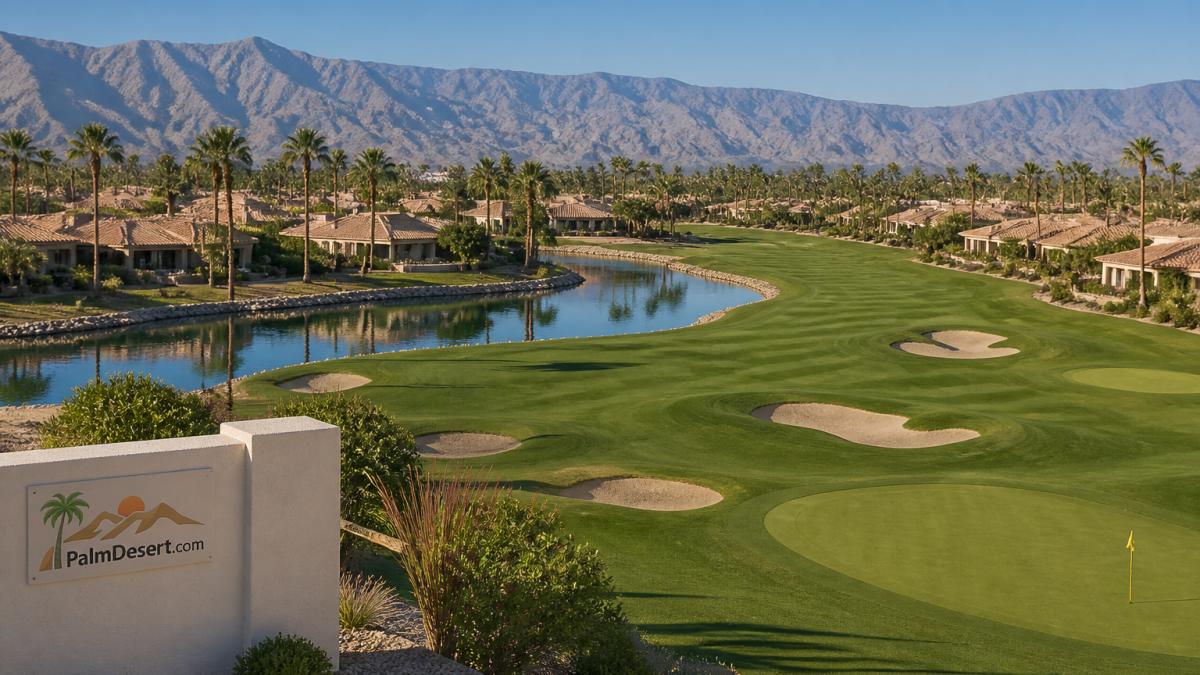 Aerial view of a championship golf course surrounded by luxury golf course communities with desert mountain views
Public vs. Private Course Access
Not all golf course communities restrict play to residents. Some operate semi-private models allowing public play during off-peak hours; others keep courses fully private. The distinction affects community character, course conditions, and social dynamics.
Private courses typically maintain tighter membership caps, ensuring less crowded conditions and stronger cohesion. Public-access models generate revenue but introduce non-residents into the community. Many buyers prefer the exclusivity and predictability of fully private courses, though semi-private options appeal to those seeking lower costs or more flexible access.
Choosing the Right Golf Course Community for Your Lifestyle
Seasonal Residents and Full-Time Living
Golf course communities in the Coachella Valley attract both seasonal snowbirds and full-time residents. Seasonal buyers typically occupy homes November through April, then leave for cooler climates. Full-time residents remain year-round, navigating summer heat and all seasons.
This shapes community dynamics significantly. Communities with high seasonal populations feel bustling in winter and quieter in summer; full-time communities maintain consistent social engagement year-round. Some buyers thrive in the seasonal rhythm; others prefer steady, year-round presence.
Summer conditions reach 110+ degrees, making outdoor activities challenging June through September. If you’re testing whether a community is the right fit before committing to purchase, consider exploring vacation rental homes in the area for a season or two, it’s an excellent way to experience the lifestyle firsthand.
Age-Restricted vs. All-Ages Communities
Many golf course communities maintain 55+ age restrictions, creating communities of peers at similar life stages.
All-ages communities attract younger buyers, families, and multi-generational households. They feel more demographically diverse but may lack the focused programming of age-restricted alternatives.
The choice depends on life stage, family plans, and social preferences. Buyers nearing retirement often prefer 55+ communities; those with young families typically choose all-ages neighborhoods.
Comparing Communities Side-by-Side
| Community Characteristic | Luxury Gated Communities | Semi-Private Golf Communities | Public Access Communities |
|---|---|---|---|
| Golf Access | Members only, tee time guaranteed | Members + limited public play | Public welcome, member priority |
| Social Programming | Extensive events, dining clubs | Regular tournaments, social events | Basic events, course-focused |
| Amenities | Multiple clubs, spas, fine dining | Clubhouse, fitness, basic dining | Clubhouse, limited amenities |
| Resident Demographics | High-net-worth, often seasonal | Mixed, professionals and retirees | Diverse, price-conscious golfers |
| Home Price Range | Premium pricing | Mid-range pricing | Lower entry costs |
| Course Exclusivity | Highly exclusive experience | Moderate exclusivity | Open, high volume play |
Luxury gated communities command premium prices but deliver exclusivity, extensive amenities, and curated social experiences. Semi-private communities balance access with community feel, appealing to serious golfers seeking peer connection without ultra-premium pricing. Public-access communities prioritize playability and affordability, attracting casual players and those prioritizing course access over exclusivity.
What to Know Before Buying in a Golf Course Community
Research the community’s financial health before committing.
Understand the specific golf membership structure tied to your home. Some purchases include mandatory golf memberships; others make membership optional.
Visit during both peak season and off-season. Winter visits reveal the seasonal crowd; summer visits show year-round resident engagement.
Evaluate course conditions and design quality firsthand. Walk the course, observe maintenance standards, and understand the layout.
Consider your actual golf commitment honestly.
At the Visitor Center for Palm Desert & Palm Springs, we help both visitors and prospective residents explore community options, understand local amenities, and discover the lifestyle fit that matters most. Browse our Desert Attractions guide to explore the broader region, or check out our vacation rental homes if you’re testing community fit before committing to purchase. For current information on Desert Events, dining, and community happenings, subscribe to our weekly newsletter to stay connected to everything happening in the valley.

Frequently Asked Questions
What are the best golf course communities in Palm Desert?
The region hosts several established golf course communities, each offering different amenities and course designs. Communities vary in size, from intimate 9-hole layouts to championship 18-hole courses. Your choice depends on whether you want a private country club atmosphere, proximity to dining and fitness facilities, or specific course conditions and difficulty levels. Seasonal residents often prioritize communities with flexible membership terms, while full-time residents may prefer those with extensive clubhouse amenities and social activities.
What amenities do golf community amenities in Palm Desert typically include?
Beyond the golf course itself, these communities feature clubhouses with dining options, swimming pools, tennis courts, fitness centers, and organized social events. Many offer resort-style living with gated access, landscaped common areas, and professional course maintenance. Some include spa facilities, pickleball courts, and walking trails. The specific amenities vary by community, so reviewing what each offers helps match your lifestyle preferences and ensure the community feels like home year-round.
Can non-residents or visitors play at golf course communities in Palm Desert?
Access depends on the community’s membership structure. Some courses are private and restricted to residents and members only. Others are semi-private, allowing public play at certain times or with a guest pass. A few communities operate public courses open to all golfers. Before purchasing a home, confirm the specific membership rules and whether you’ll have guaranteed tee times, guest privileges, and any associated fees or obligations for course access.
Are golf course communities suitable for seasonal residents?
Yes, many communities welcome seasonal residents, especially snowbirds seeking winter escapes. Some offer flexible membership terms that adjust for seasonal occupancy, while others charge annual fees regardless of usage. Communities with strong social calendars and organized activities tend to suit seasonal residents well. Check whether the community operates year-round services, whether maintenance fees apply during months you’re absent, and if membership includes reciprocal play at other courses during your off-season.