Table of Contents
- What Cybercabs and Driverless Ride Service Mean for Palm Desert
- Current Transportation Options in the Coachella Valley
- How Cybercabs Work: Steering-Wheel-Free Design and Autonomous Driving Software
- Autonomous Vehicle Regulations: Where Federal and State Rules Stand
- Are Driverless Ride Services Operating in the Coachella Valley Yet?
- Cost-Benefit Analysis: Robotaxis vs. Traditional Shuttles
- Accessibility Features in Autonomous Vehicles
- What to Expect for the Future of Transit in the Coachella Valley
- Frequently Asked Questions
Last Updated: September 11, 2026
What Cybercabs and Driverless Ride Service Mean for Palm Desert
Cybercabs are fully autonomous, steering-wheel-free vehicles that pick up passengers and drive them point to point without a human operator. For the Coachella Valley, a driverless ride service would mean on-demand mobility that runs on your schedule, not a bus timetable. This guide breaks down where the technology stands, what California regulators allow, and what it means for getting around the desert.
Here’s the honest version: no cybercab is picking you up on El Paseo today. But the rules, the vehicles, and the local transit groundwork are all moving in that direction.
Current Transportation Options in the Coachella Valley
Today’s Coachella Valley transportation mix is rideshare, chauffeur and car services, electric shuttles, and public transit. Each covers a different need, and none handles every trip well.
Autonomous vehicles won’t arrive into a vacuum. They’ll compete with, and eventually complement, what already exists, and the real test for any driverless ride service is whether it beats what you can book right now.
Rideshare, Chauffeur Services, and Electric Shuttles
Rideshare apps dominate short trips: a run to dinner, a lift home from an event, an airport transfer. Their weakness is predictability, during major events, wait times stretch and surge pricing kicks in, exactly when visitors need a ride most.
Chauffeur and private car services solve that problem for a price. You book ahead, the car shows up, and the rate doesn’t move. For business travelers and event nights, that reliability is often worth the premium.
Electric shuttles occupy the middle ground: fixed or semi-fixed routes for resorts, venues, or community programs, quiet, zero-emission, and cheap per mile. If you’ve ridden one, you’ve experienced the vehicle class most autonomous shuttles are built on.
SunLine Transit and Local Shuttle Services
SunLine Transit Agency operates the valley’s public bus network and has spent years converting its fleet to hydrogen and alternative fuels, making the region an unusual testing ground for clean transit. Local shuttle services fill the last-mile gaps between resorts, venues, and parking areas.
The pattern to notice: the valley already runs on a mix of scheduled transit and on-demand rides. Autonomous vehicles slot in as another on-demand layer, not a replacement for the whole system.
How Cybercabs Work: Steering-Wheel-Free Design and Autonomous Driving Software
A cybercab is built from the ground up without a steering wheel or brake pedals, relying entirely on autonomous driving software to navigate. No driver’s seat means more passenger space, and the cabin becomes a lounge rather than a cockpit.
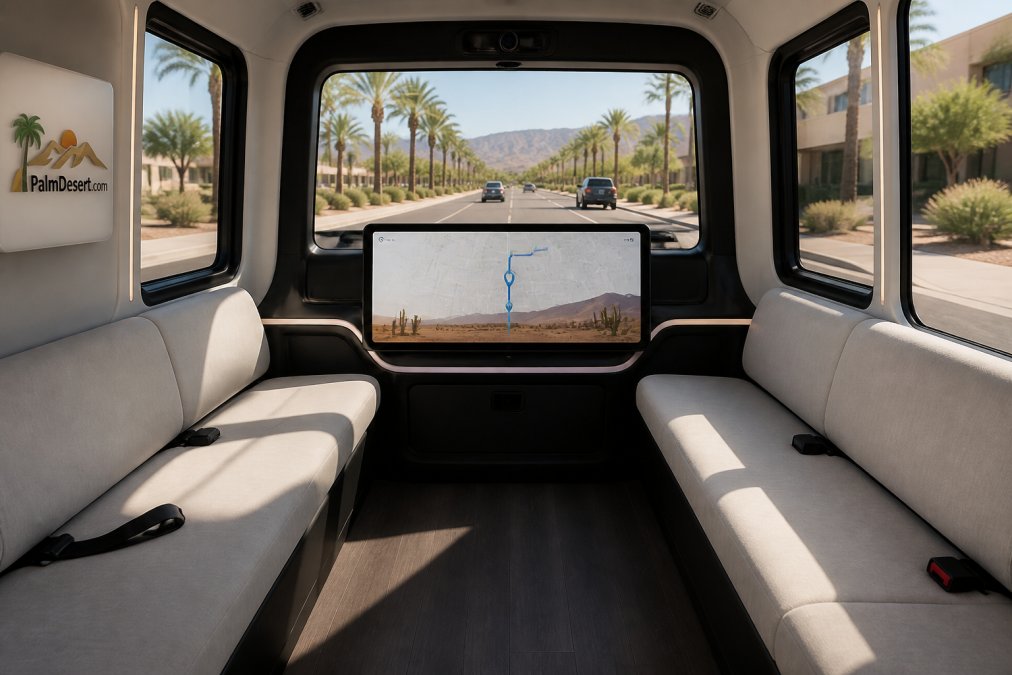
The technology stack combines lidar, cameras, radar, and detailed mapping data, processed in real time by autonomous driving software that predicts what pedestrians, cyclists, and other cars will do next. The system handles the entire trip, though remote operators can assist if a vehicle encounters something unusual.
What most coverage misses is that the hard part isn’t driving. It’s the operational layer: fleet deployment, charging schedules, cleaning, maintenance, and ride scheduling. A driverless ride service is a logistics business that happens to use cars.
Autonomous Vehicle Regulations: Where Federal and State Rules Stand
Autonomous vehicle regulations in the United States are split between federal vehicle safety standards and state-level operation rules. The National Highway Traffic Safety Administration sets the Federal Motor Vehicle Safety Standards every vehicle sold here must meet, and is working through how they apply to vehicles built without a steering wheel or pedals. States decide who may test and who may carry passengers on their roads.
For anyone tracking a driverless ride service in the Coachella Valley, the state level is where the action is. California has built the most detailed framework in the country, and it governs every commercial autonomous trip in the state.
California DMV and CPUC Oversight
Two agencies share the job, and they regulate two different things.
The California Department of Motor Vehicles issues autonomous vehicle permits in tiers: a testing permit with a safety driver aboard, a driverless testing permit with no one in the driver’s seat, and a deployment permit allowing commercial operation of the vehicle itself (dmv.ca.gov). The DMV publishes the list of companies holding each tier, the fastest way to check whether an operator is real.
The California Public Utilities Commission then regulates passenger service, the part where a company charges a fare to move people. A company can hold a DMV deployment permit and still be barred from carrying paying passengers until the CPUC approves its service under its autonomous vehicle passenger service rules. The CPUC also requires data reports and, in most cases, a charter-party carrier permit as a base for passenger operations.
That two-step structure matters for a local rider. Any legitimate driverless ride service in California will appear in both agencies’ public records. You can check the California DMV autonomous vehicle permit holder list and the CPUC autonomous vehicle passenger service proceedings directly.
What a Regional Regulatory Roadmap Would Look Like
Most coverage stops at the state framework. The more useful question for the Coachella Valley is what a local operator would have to clear before a cybercab could pick up a passenger on El Paseo or run a shuttle loop between resorts.
A realistic sequence looks like this:
- DMV testing permit with a safety driver. The operator proves the vehicle on public roads with a human monitor. This is the entry tier and the one most pilot programs sit in.
- DMV driverless testing permit. The safety driver comes out. The operator must show remote monitoring, a communication link to the vehicle, and a plan for law enforcement interaction.
- DMV deployment permit. The vehicle itself is approved for commercial operation. This is where the hardware stops being a prototype.
- CPUC passenger service approval. The operator is cleared to charge fares. This is the step that turns a test into a business.
- Local coordination. Cities and the county control the street-level pieces: pickup and drop-off zones, curb access, business licenses, and any agreements for shuttle stops on public property. Riverside County and the individual desert cities each have their own say over where a vehicle can stop and wait.
That last step is the one national coverage skips, and it determines whether autonomous service reaches the desert before a larger metro. A regional roadmap isn’t a single document, it’s the stack of state permits plus local curb and licensing decisions layered on top.
Book Hotels with Exclusive Discounted Rates Now →
Are Driverless Ride Services Operating in the Coachella Valley Yet?
No. As of 2026, no driverless ride service is carrying passengers in the Coachella Valley, and no cybercab fleet is deployed here. Commercial autonomous passenger service in California is concentrated in the state’s largest metro areas, not the desert.
That doesn’t mean nothing is happening. The valley has a track record of adopting alternative-fuel transit early, and the same pattern is likely to repeat with autonomous shuttles.
The Phased Path to Local Service
Autonomous transit rarely arrives as a full point-to-point network. It arrives in stages:
- Phase 1, Closed and campus routes. Shuttles run on private roads, resort loops, or defined campus-style circuits where the operator controls the environment. Speeds are low, routes are short, and a safety monitor is typically aboard. This is the lowest-friction way to prove the technology in a desert climate.
- Phase 2, Permitted public routes with a monitor. The shuttle moves onto public streets on a fixed loop, still with a safety monitor. This is where DMV and CPUC approvals start to matter for the operator, and where local cities get involved in stop placement.
- Phase 3, Driverless public routes. The monitor comes out. The route is still fixed, but the vehicle operates without anyone aboard. This is the first stage a visitor would recognize as a driverless ride.
- Phase 4, Point-to-point service. On-demand trips anywhere in a service area. This is the cybercab model, and it is the last stage to arrive, not the first.
Most of the valley’s near-term autonomous activity, if it comes, will sit in Phases 1 and 2, fixed loops and shuttle-style service, not hail-anywhere robotaxis.
What Would Have to Be True First
Three conditions have to line up first:
- A permitted operator. Someone has to hold the DMV and CPUC approvals described above and choose the valley as a service area. Operators go where density and demand justify the fleet, and the valley’s seasonal population swings make that math harder than in a year-round metro.
- Charging and depot infrastructure. Autonomous fleets need somewhere to charge, clean, and stage between trips. That real estate has to exist before the vehicles do.
- Local curb and stop agreements. Cities and the county control where vehicles can pick up and wait. Without those agreements, even a permitted operator has nowhere to stop.
The honest read: the technology is real, the state framework is in place, and the local groundwork is the missing piece. When autonomous service reaches the valley, expect a shuttle first and a cybercab later.
Cost-Benefit Analysis: Robotaxis vs. Traditional Shuttles
Robotaxis and traditional shuttles win on different economics. A robotaxi’s advantage is flexibility: it goes where you want, when you want, with no fixed route. A shuttle’s advantage is cost per passenger, spreading the trip across many riders.
|
Factor |
Robotaxi |
Traditional Shuttle |
|---|---|---|
|
Route |
Point to point |
Fixed or semi-fixed |
|
Cost per rider |
Higher, single party |
Lower, shared |
|
Availability |
On demand |
Scheduled |
|
Best for |
Airport runs, event nights, errands |
Resort loops, venue transfers, group moves |
|
Driver cost |
None |
Paid operator |
For a valley visitor, the math is straightforward. A couple heading to dinner is fine with an on-demand vehicle; moving twelve people between a hotel and a venue, a shuttle wins on cost every time.
The unresolved question is insurance and liability, one of the largest cost variables for any autonomous fleet. Until that settles, expect operators to price conservatively.
Accessibility Features in Autonomous Vehicles
Accessibility is where autonomous vehicles could genuinely outperform today’s options, and it’s the angle most coverage ignores. A vehicle with no driver’s seat and a flat floor can be designed around wheelchairs, walkers, and mobility aids from the start rather than retrofitted.
Key features in development include:
- Level boarding with ramps or kneeling suspension, removing the step up into a standard car
- Wheelchair securement built into the floor rather than bolted in afterward
- Voice and app controls for door operation, climate, and trip changes
- Audio and visual stop announcements for riders with low vision or hearing
- Remote human assistance when a rider needs help mid-trip
For the valley’s large retiree and seasonal population, these aren’t fringe benefits. They’re the difference between staying independent and relying on others for every appointment.
What to Expect for the Future of Transit in the Coachella Valley
Expect autonomous transit to reach the Coachella Valley gradually, starting with shuttles on defined routes and expanding only as state rules and local infrastructure allow. Dedicated pickup zones and charging infrastructure have to exist first.
The timeline runs in phases: pilot shuttles on private or campus roads, then permitted public routes with a safety monitor aboard. Only then does point-to-point driverless service become plausible.
Meanwhile, the practical move is to plan trips around what actually exists. The Visitor Center for Palm Desert & Palm Springs maintains current valley transit and attraction resources alongside its travel planning tools so you can build an itinerary around real, bookable options rather than promises.
The valley’s transit future is coming, but it isn’t here yet, and planning a trip around vehicles that don’t exist is a good way to spend an afternoon waiting on a curb. The Visitor Center for Palm Desert & Palm Springs helps you plan with what’s real: curated hotel and vacation rental listings, up-to-date event and attraction information, and a single place to check local news before you book. Subscribe to our weekly updates and get the valley’s transit, event, and travel news as it actually happens.
Frequently Asked Questions
Are there autonomous ride services currently operating in the Coachella Valley?
No driverless ride service is currently operating commercially in the Coachella Valley. Companies like Waymo and Tesla have launched robotaxi trials in other cities, but no operator has received the permits needed to deploy cybercabs in Palm Desert or surrounding areas. Visitors and residents still rely on rideshare, chauffeur services, and electric shuttles for on-demand mobility.
What is the difference between a traditional rideshare and a cybercab?
A traditional rideshare pairs you with a human driver who owns or leases the car. A cybercab is a purpose-built autonomous vehicle with no steering wheel or brake pedals, relying on autonomous driving software and sensors to navigate. The cybercab model aims to reduce labor costs and improve transit efficiency, but it requires regulatory approval and fleet deployment before it can serve passengers.
How do current autonomous vehicle regulations affect driverless vehicle testing?
Autonomous vehicle regulations in California require companies to obtain permits from the DMV and, for commercial passenger service, from the CPUC. Testing must meet safety protocols and reporting requirements. These rules apply statewide, so any driverless ride service hoping to operate in Palm Desert would need to clear the same regulatory hurdles as operators in larger metros.
What transportation options are available for visitors today?
Visitors can choose from rideshare apps, traditional taxi and chauffeur services, SunLine Transit buses, and electric shuttles that serve select routes. For point-to-point transportation, rideshare remains the most common choice. Rental cars and hotel shuttles also cover many needs. These options provide last-mile connectivity until robotaxis become available.