Table of Contents
- Best Pickleball Courts in Coachella Valley: What Players Should Know
- Public Parks vs. Private Courts: Where the Best Pickleball Courts Are
- Indoor vs. Outdoor Facilities: Playing Through Desert Heat
- Court Surfaces, Lighting, and Amenities That Matter
- Pickleball Lessons Coachella Valley: Clinics and Private Coaching
- Best Pickleball Resorts for Travelers and Snowbirds
- Reservations, Peak Hours, and Tournament Play
- Conclusion: Choosing Your Court
- Frequently Asked Questions
Last Updated: October 3, 2026
Best Pickleball Courts in Coachella Valley: What Players Should Know
Finding the best pickleball courts in Coachella Valley comes down to matching the right facility to your skill level, schedule, and tolerance for desert heat. This guide from the Visitor Center for Palm Desert breaks down public parks, private clubs, indoor options, and resort courts so you can plan a session that actually fits your trip.
Pickleball courts are purpose-built or converted playing surfaces with a 34-inch net, a 20-by-44-foot court, and a non-volley zone known as the kitchen. The desert has quietly become one of the best places in the country to play, thanks to year-round sunshine and a growing number of lighted, fenced facilities.
Below, we cover where to play, when to play, and how to get on a court during peak season. The 55+ communities and resort corridors here have turned a niche paddle sport into a genuine social scene, and knowing the difference between a drop-in park and a membership club saves you a wasted morning.
Match the facility to your goal: public parks for casual drop-in play, private clubs for skill-based grouping and reserved courts, resorts for convenience when you’re staying on property.
Public Parks vs. Private Courts: Where the Best Pickleball Courts Are
The best pickleball courts in Coachella Valley split into two clear categories: free public parks with drop-in play and private clubs with reserved courts and organized programming. Both have a place, depending on how you like to play.
Public Parks and Drop-In Play
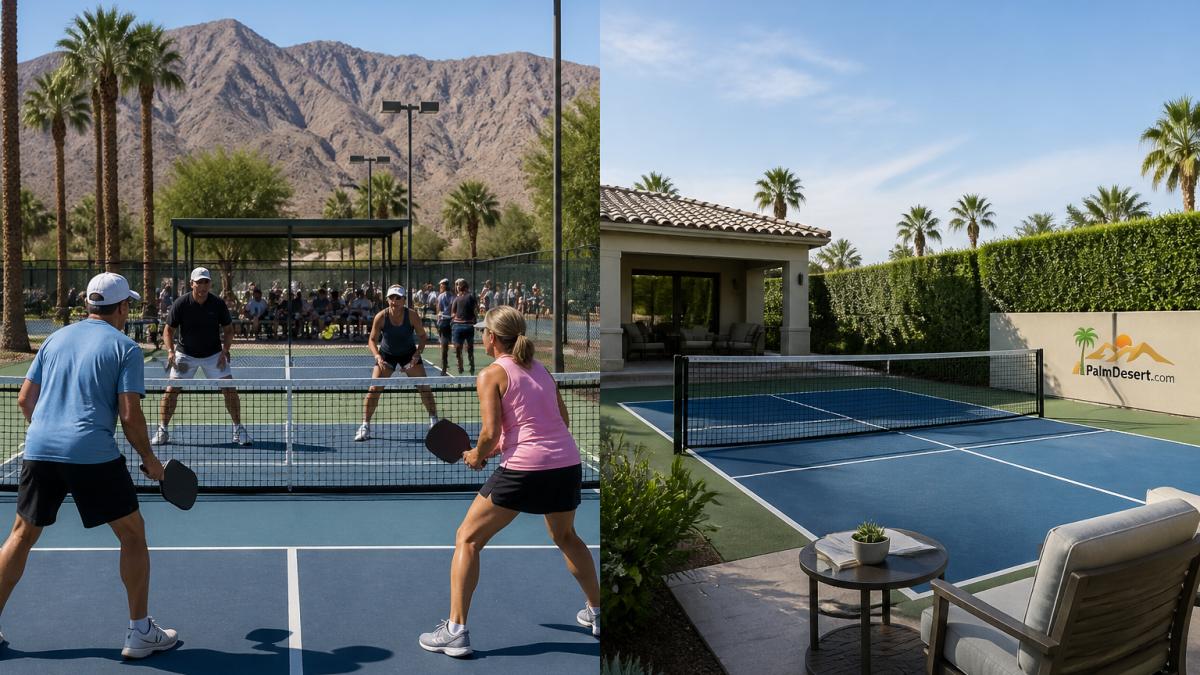
Public parks are the most accessible entry point for recreational play. Most offer hard courts with painted lines, and many have lighted facilities for evening sessions once the heat drops. Drop-in fees are often low or nonexistent, and open play typically runs on a first-come, round-robin rotation.
The trade-off is demand. During peak hours in winter, courts fill fast and you may wait through several rotations. Arriving early or playing off-peak mid-morning improves your odds considerably.
Membership Clubs and Resort Courts
Membership clubs solve the availability problem. They offer court reservations, skill-based grouping, and organized clinics, which matters if you want competitive play rather than casual rallies. Membership tiers vary, and pricing depends on the club and season, so check directly with each facility.
Resort courts sit in the middle. Guests get convenient access without a separate membership, though court capacity can be limited during busy travel periods.
Indoor vs. Outdoor Facilities: Playing Through Desert Heat
Indoor facilities let you play through summer, while outdoor courts are best in the cooler months. That single distinction shapes how locals schedule their year.
Summer daytime temperatures push most outdoor play to early morning or after sunset, when lighted courts become essential. Indoor venues, often attached to community centers or fitness clubs, keep the game going when the mercury climbs.
Seasonal Weather Strategy: When to Play
Timing is everything here. From late fall through early spring, outdoor courts are comfortable nearly all day. In summer, the window narrows to dawn and dusk.
A practical approach many players use:
- October to April: outdoor play any time; expect the busiest courts on weekends
- May to September: early morning or evening only; prioritize indoor or shaded facilities
- Peak snowbird season: reserve courts or arrive early to beat the queue
This is where visitors from cooler climates have an edge in planning. Treat the desert season like an inverted calendar.
Court Surfaces, Lighting, and Amenities That Matter
Court surface, lighting, and amenities separate a good session from a frustrating one. Hard courts dominate the region, and the quality of maintenance varies widely between facilities.
What to look for before you commit to a facility:
- Court surface: smooth, well-maintained hard courts with clear lines and no cracks
- Lighting: lighted facilities for evening play, especially in summer
- Net availability: permanent nets beat shared or missing ones
- Shade and hydration: shaded seating and hydration stations are not luxuries in the desert
- Parking accessibility: close parking matters when you’re carrying gear in the heat
Fenced courts reduce stray-ball interruptions, which sounds minor until you spend a session chasing balls into a parking lot.
Skill-Based Grouping and Player Ratings
Skill-based grouping is the difference between a fun game and a lopsided one. Many clubs and organized open-play sessions use player ratings to sort participants, so beginners aren’t thrown into advanced competitive play.
If you’re new, ask about beginner-friendly sessions. If you’re experienced, ask whether the facility runs advanced competitive play or tournament-grade rotations. Getting this right is the single biggest factor in whether you enjoy the session.
Ask the front desk which hours draw which skill levels. Mid-morning often skews beginner-friendly, while early evening tends to attract stronger players. Showing up at the wrong block is the most common reason visitors have a bad first game.
Pickleball Lessons Coachella Valley: Clinics and Private Coaching
Pickleball lessons in Coachella Valley range from group clinics to one-on-one private lessons, and they’re the fastest way to move from casual to competitive. Group clinics suit beginners learning the basics, while private lessons target specific weaknesses like the third-shot drop or dinking. Equipping yourself with the right beginner pickleball paddles ensures that the technical skills practiced during these sessions translate effectively to consistent performance on the court.
Most facilities run clinics on a weekly schedule, and many pair them with open-play sessions so you can practice immediately. If you’re visiting for a week, a single clinic can plug you into the local player network faster than showing up cold.
For snowbirds staying the season, a recurring clinic doubles as a social anchor. You’ll see the same faces weekly, which is how most people here build their desert community.
Best Pickleball Resorts for Travelers and Snowbirds
The best pickleball resorts combine on-site courts with the amenities travelers already want: pools, dining, and easy access to the region. For visitors, staying where you play removes the logistics of hauling gear across the valley.
Resort-style amenities and court access together make a stay feel less like a commute and more like a routine. If you’re booking a longer winter stay, a vacation rental near a cluster of courts often works better than a single resort, since you can rotate between several facilities.
Book Hotels with Exclusive Discounted Rates Now →
Equipment Rentals and Post-Game Socializing
Equipment logistics are the number-one frustration for visiting players, and most guides skip them entirely. Here’s how to solve it before you land.
Paddle and ball rentals. Many facilities with pro shops rent paddles and sell balls, and some let you demo a paddle before buying. Availability is not universal: community-center courts and bare public parks frequently expect you to bring your own gear. A common pattern is that staffed, membership-style clubs and larger resort sports desks rent; unstaffed park courts do not.
What to pack if you’d rather not rent. A paddle travels fine in a carry-on if you remove it from a bulky bag, and balls pack flat. Many travelers ship a paddle ahead to their hotel or rental rather than risk a checked bag. If you’re staying a full season, buying an entry-level paddle locally is often simpler than renting repeatedly.
Shoes and surface. Desert hard courts are abrasive. Court shoes with good lateral support matter more here than on a soft indoor surface, and a spare pair of socks is worth packing for a multi-session day.
Post-game socializing. Courts here function as community hubs, and the 55+ communities have built entire social calendars around them. The practical move: after your rotation ends, linger near the bench or the shade structure. Open-play groups often decide their next stop on the spot, and a simple “anyone grabbing lunch?” is how visitors get absorbed into the local scene.
Don’t assume every facility rents paddles. Some parks and clubs expect you to bring your own gear, and showing up empty-handed means watching from the bench. Confirm rental availability before you drive out.
If you’re flying in, call the pro shop the morning of your first session and ask whether they hold a loaner paddle for drop-in players. Many do, but only if you ask.
Reservations, Peak Hours, and Tournament Play
Reservation policies vary sharply by facility type, and understanding them prevents wasted trips. Private clubs typically allow court reservations for members, while public parks often run open play with no booking. The mechanism matters more than the label, so here’s how each actually works.
How open play rotations run. At most public parks, you put your paddle in a rack or on a bench to hold your spot in line. When a court frees up, the next four paddles go out. Winners often split and rotate, so you may play with new partners every game.
How to find partners as a solo player. Ask the front desk or a regular which block draws your skill level. Mid-morning sessions often skew beginner-friendly, while early evening tends to attract stronger players.
Peak hours. Early morning and late afternoon fill first, plus all day on winter weekends. Off-peak mid-day slots in summer are the easiest to grab. If you want guaranteed court time, a reservation beats hoping for an open rotation.
Tournament and event hosting. Facilities built to tournament-grade standards host round-robin events and larger competitions, which draw players from across the region. If you’re competitive, ask which venues run regular tournaments and how to register, most publish a schedule and a registration window, and brackets often fill before the event date.
| Facility Type | Best For | Reservations | Typical Access |
|---|---|---|---|
| Public parks | Casual drop-in play | Usually not offered | Open play, paddle-stack rotation |
| Membership clubs | Skill-based grouping, clinics | Yes, for members | Membership tiers |
| Resort courts | Travelers staying on-site | Often for guests | Guest access |
| Indoor facilities | Summer play, heat avoidance | Varies by venue | Drop-in or booked |
If you’re visiting for a week, a single clinic plugs you into the local player network faster than showing up cold. You’ll leave with names, a group chat invite, and a standing game.
Conclusion: Choosing Your Court
The valley rewards players who plan around the heat and the season rather than fighting both. Pick your facility type first, then your time slot, and the rest falls into place.
When you’re ready to build the trip around your game, the Visitor Center for Palm Desert helps you find Palm Desert hotels and resorts close to the courts, plus vacation rental homes with the privacy and space a longer stay needs. Our travel planning tools and weekly local updates keep you current on events and facility news.
Subscribe to get started and plan a desert stay built around the courts you actually want to play on.
Frequently Asked Questions
Where are the best public pickleball courts in the Coachella Valley?
Public pickleball courts in the Coachella Valley are concentrated in city parks across Palm Desert, La Quinta, Indio, and Cathedral City. Most offer multiple hard courts, and many have lights for evening play. Courts fill early during peak season, so arriving before 8 a.m. helps secure a spot. Check each city’s parks department for current court counts and hours.
Do I need a reservation to play pickleball at local parks?
Most public parks in the Coachella Valley use open play or drop-in formats rather than reservations, especially during morning hours. Some facilities take court reservations for specific blocks, and clubs may hold scheduled round-robin sessions. Policies vary by city, so confirm with the parks department or the on-site club before you go.
Are there pickleball lessons available for visitors in the area?
Yes. Pickleball lessons in the Coachella Valley range from beginner clinics at public parks to private coaching at membership clubs and resorts. Many instructors group players by skill level, so visitors can join a clinic matching their rating. Lessons often run in morning or evening blocks to avoid peak heat. Contact the facility directly for schedules.
What are the best times of day to play pickleball in the desert heat?
Early morning and after sunset are the most comfortable times to play outdoors in the Coachella Valley, particularly from late spring through early fall. Lighted courts extend evening play, while indoor facilities offer climate-controlled options during the hottest months. Carry water, use shaded seating between games, and check whether your chosen court has hydration stations.
USA Pickleball official rules and court specifications
National Park Service heat safety guidance for desert recreation
CDC guidance on hydration and heat-related illness prevention