Visitor Center for Palm Desert & Palm Springs

Sunrise Hot Air Balloon Flight: How to Plan Your Adventure

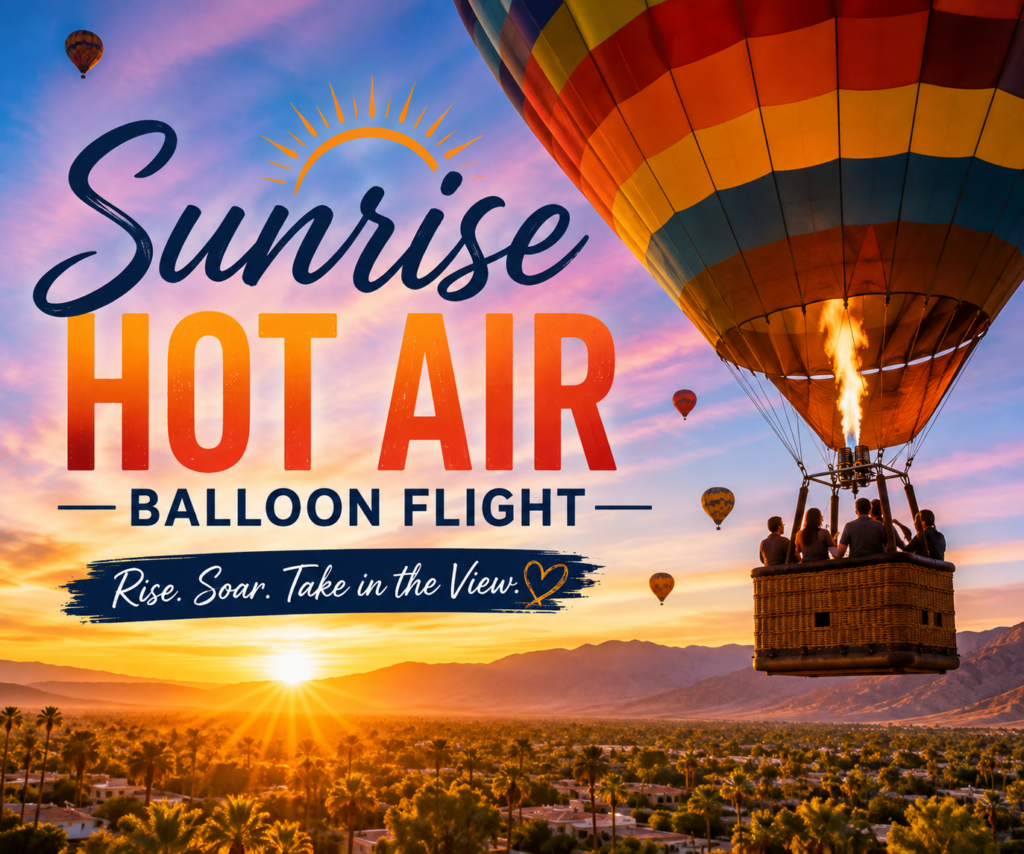
Sunrise Hot Air Balloon Flight

Click Here for Your Sunrise Hot Air Balloon Flight Booking

If you are planning a trip to Palm Springs, you probably already have lounging by the pool, grabbing great food, and admiring the palm trees on your itinerary. But if you want an experience you will actually talk about for years, set your alarm early and head up into the sky to Sunrise Hot Air Balloon Flight.

There is nothing quite like floating high above the Coachella Valley right as the sun comes up. As the morning light hits the San Jacinto Mountains, the entire desert lights up below you. It is quiet, surprisingly smooth, and easily one of the coolest ways to see Southern California.

I know early wake-up calls on vacation can be a tough sell, but trust me—this one is 100% worth it.

To help you plan, this guide breaks down everything you need to know about taking a sunrise flight with Palm Springs Balloons. We will cover how the morning works from start to finish, what you should pack, and why this quick morning trip deserves a spot right at the top of your Palm Springs bucket list.

Practical Logistics & Flight Overview

Planning a balloon ride is surprisingly straightforward, but because these flights depend entirely on the morning weather, knowing the ground rules ahead of time makes for a smooth, stress-free morning.
Here is a quick snapshot of what you need to know before booking your flight with Palm Springs Balloons:
Details What to Expect
Meeting Location 78752 CA-111, La Quinta, CA 92253 (A quick 20-to-25-minute drive from downtown Palm Springs).
Start Time Early morning check-in, typically between 4:30 AM and 5:30 AM (varies slightly depending on the sunrise time).
Time Airborne 45 to 60 minutes in the basket.
Total Experience Plan for about 2.5 to 3 hours total, including ground transport, setup, flight time, and the post-landing celebration.
Flight Season Daily sunrise flights run seasonally from November through May, when desert weather conditions are optimal.
Group Size Small-group shared baskets hold 10 passengers max, giving everyone an unobstructed edge-of-the-basket view.
Included Extras Shuttle van transport to/from the launch site, plus a post-flight champagne/mimosa toast (with non-alcoholic juices and sodas available).
Average Pricing Shared flights start at ~$300 per person; private basket options for couples or groups run higher.
Quick Tips Before You Book
  • Book early in your trip: Always schedule your flight for the first or second morning of your stay in Palm Springs. If morning winds force a raincheck, you will still have a buffer day or two to reschedule.
  • Keep your morning open: While the flight itself is an hour, do not plan high-stress breakfasts or early morning tee times immediately after. Give yourself a relaxed buffer so you can enjoy the post-flight champagne toast without rushing.

Step-by-Step Experience Breakdown

If you have never been in a hot air balloon before, you might wonder how the morning actually flows. From the moment you pull up to the meeting spot to the final champagne glass, the whole process is surprisingly smooth and relaxed.
Here is what your morning looks like from start to finish.
1.Phase 1:

Pre-Dawn Check-In & Shuttle Ride: Meeting up and heading to the launch field.

Your morning starts at the designated meeting hub in La Quinta, well before the sun comes up. After checking in with the team and meeting your pilot, you will jump into an air-conditioned passenger van.
Because balloons drift with the wind, the pilot picks the exact launch field that morning based on wind direction. The short van ride to the site is a great time to wake up, chat with fellow riders, and get a quick safety briefing.
2.Phase 2:

The Inflation Spectacle:Watching the balloon come to life.

When you arrive at the launch field, the crew goes straight to work. First, they lay out the massive fabric envelope across the grass or desert floor and use large industrial fans to blow cold air inside.
Once the balloon is filled out, the pilot fires up the propane burners. Watching the flame light up the dark field and seeing the gigantic balloon stand straight up is an awesome photo op, so keep your phone ready.
3.Phase 3:

The Sunrise Flight:45 to 60 minutes floating above the valley.

Climbing into the basket is easy, and before you even realize you’ve left the ground, you are floating. Unlike helicopters or airplanes, there is no sudden engine roar or stomach-drop feeling—just a smooth, gentle rise.
As the sun climbs over the horizon, you get 360-degree views of the San Jacinto and Santa Rosa Mountains, sprawling polo fields, golf courses, and the desert floor stretching out below. Your pilot will move the balloon to different altitudes to catch light wind currents and guide your path over the valley.
4.Phase 4:

Smooth Landing & Champagne Toast:Wrapping up with an 18th-century tradition.

Your pilot will bring the basket down for a soft landing in an open field, where the ground crew will be waiting to help everyone out.
Once you are back on solid ground, you’ll join in on a traditional hot air ballooning custom: a complimentary champagne or mimosa toast (or juice/soda if you prefer). After celebrating a great flight and snapping a few group pictures, the crew loads everyone back into the van for a quick ride to your car.

Why Dawn? The Science & Microclimate Advantage

You might be wondering why you have to wake up at 4:30 AM on a vacation day just to catch a balloon flight. It is not just about catching a pretty sunrise for your social media feed—there is actual science behind why early morning is the safest, smoothest, and best time to fly.

The Desert Atmosphere at Work

  • Calm Air & Thermal Stability: As the sun heats up the desert floor during the day, the ground warms the air directly above it. That warm air rises quickly in uneven columns called thermals, creating invisible bumps and turbulent gusts. At dawn, the desert air is at its absolute coolest and most stable, giving you that glass-smooth, effortless float.
  • Maximum Lift Physics: Hot air balloons work on simple buoyancy—hot air inside the balloon envelope is lighter than the cooler air outside it. Because desert mornings are crisp and cool, the difference in temperature between the inside of the balloon and the outside air is at its highest. This gives the balloon maximum lift while using much less propane fuel.
  • Light Morning Winds: Surface winds are almost always at their gentlest right around sunrise. This makes both the liftoff and the final landing soft, predictable, and stress-free.

The Golden-Hour Visual Benefit
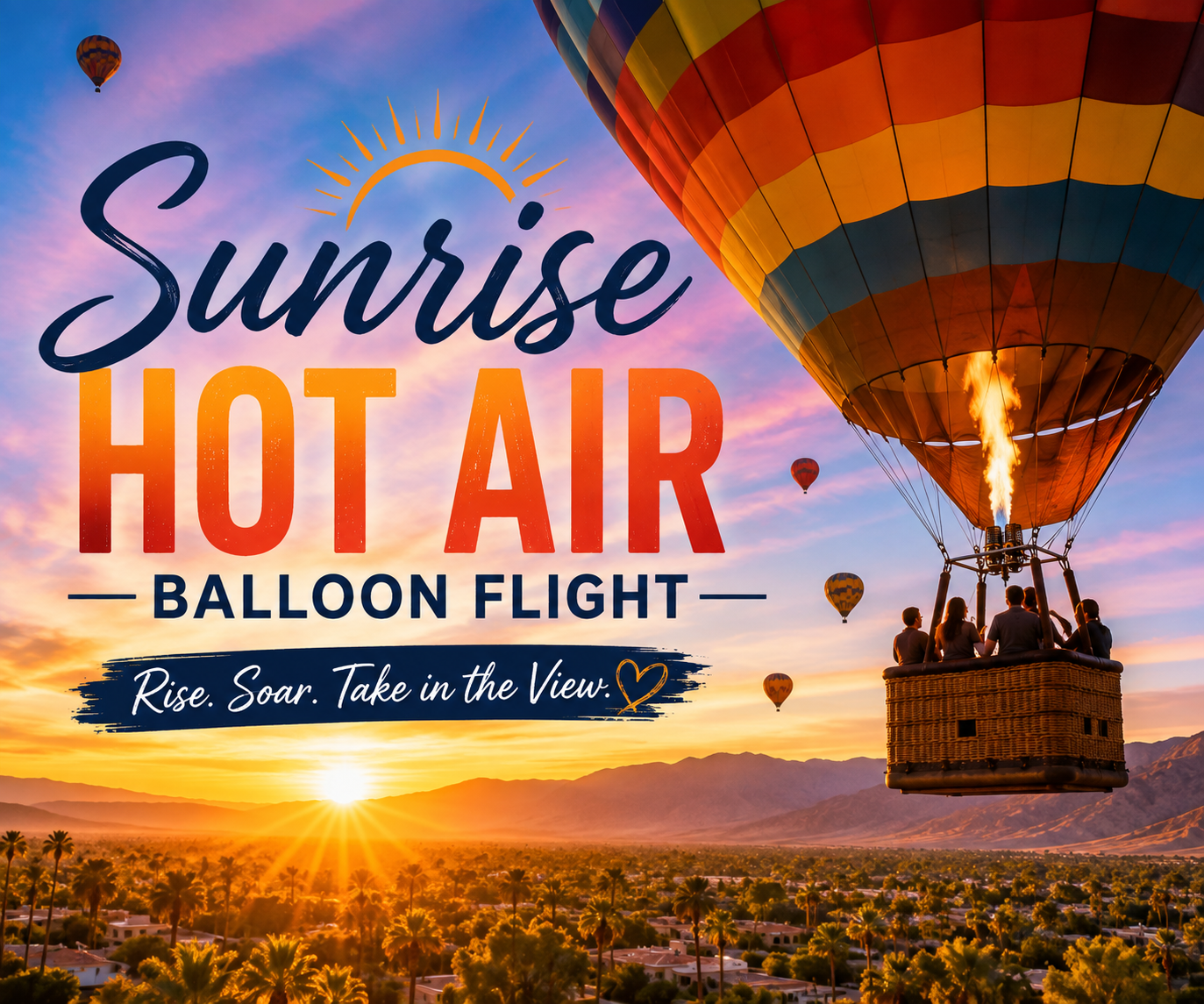
From a purely visual perspective, the early morning sun completely changes how the Coachella Valley looks.
Because the sun rises low on the eastern horizon, it casts long, dramatic shadows across the canyons and ridges of the San Jacinto Mountains. The light turns the rocky terrain deep shades of orange and gold, giving you bright, clear contrast for photos that you simply cannot get in the middle of the day.
Sunrise Hot Air Balloon Flight

Essential Preparation & Packing Guide

Getting ready for a sunrise balloon flight is pretty straightforward, but a little prep goes a long way toward keeping you comfortable while you are up in the air.

What to Wear

  • Dress in Layers: Desert mornings can be surprisingly chilly before dawn, but it warms up quickly once the sun breaks over the mountains. Start with a light jacket or cozy fleece over a t-shirt so you can shed layers as the morning heats up.
  • Flat, Closed-Toe Shoes Are a Must: Leave the sandals and heels at the hotel. Launch and landing sites are often in unpaved desert fields with loose dirt, brush, or gravel. Comfortable sneakers or light walking shoes are your best bet.
  • Bring a Brimmed Hat: The propane burners overhead throw off a noticeable amount of radiant heat during the flight. If you are tall or sensitive to heat, a baseball cap or beanie keeps your head comfortable.
  • Long Pants: Jeans or athletic pants work best for stepping in and out of the basket and walking through light desert brush after landing.

What to Pack in Your Bag

  • Camera or Phone (With a Strap): The views are incredible, so you will definitely want photos. Just make sure your phone or camera has a wrist strap or lanyard—dropping anything out of a basket at 1,000 feet means it is gone for good.
  • Sunglasses: Once the sun crests the horizon, the desert glare gets bright fast.
  • Small Crossbody Bag: Space inside the wicker basket is limited, so leave large backpacks in your car. A small crossbody bag or hip pack is ideal for keeping your hands free.

Physical Requirements & Accessibility

  • Standing Comfort: You will be standing upright in the basket for the entire 45-to-60-minute flight, so wear supportive shoes.
  • Climbing In and Out: Balloon baskets do not have doors. Getting in requires stepping onto foot-holes built into the side of the wicker basket and swinging your leg over a waist-high wall (the crew is always right there to lend a steady hand).
  • Motion Comfort: If you are worried about motion sickness, you can breathe easy. Because the balloon moves seamlessly with the wind, there is no rocking, swaying, or turbulence like you might feel on a boat or small plane.

Booking Information, Pricing & Policies

Locking in your hot air balloon ride is easy, but because morning flights sell out fast during peak desert season, a little advance planning goes a long way. Here is everything you need to know about pricing, ticket options, and how weather policies work with Palm Springs Balloons.

Shared vs. Private Flight Pricing

Whether you want to share the adventure with fellow travelers or keep the basket entirely to yourself, there are two primary ways to fly:
  • Shared Sunrise Flights (~$300 per person): This is the most popular choice for couples, solo travelers, and small groups. Baskets hold roughly 6 to 12 passengers max, meaning everyone gets a clear view over the edge without feeling crowded.
  • Private Sunrise Flights (Starting around $2,000 per couple): Perfect for proposals, anniversaries, or special celebrations. You get the whole balloon and pilot to yourselves for an ultra-romantic, intimate morning.

Booking & Cancellation Rules

  • How Far Out to Book: The flying season in Palm Springs runs from November 1st through May 31st. Peak months (especially around festival seasons, holidays, and spring break) fill up weeks in advance, so try to reserve your spots 2 to 3 weeks ahead.
  • Standard Cancellation Window: If your plans change, you can generally cancel or reschedule free of charge as long as you give at least 48 to 72 hours’ notice before your scheduled flight. Last-minute cancellations or no-shows inside that window are non-refundable.

What Happens If Weather Cancels Your Flight?

Safety comes first in aviation. Because hot air balloons rely on gentle winds and clear skies, high winds, heavy fog, or rain will ground a flight.
  • The Pilot’s Call: Pilots check weather forecasts continuously overnight and make the final safety call early in the morning.
  • Your Options: If your flight is canceled due to bad weather, you are never penalised. You can either reschedule for an alternative morning during your stay or get a 100% full refund—no questions asked.
  • Pro Tip: Schedule your flight for the first or second day of your Palm Springs trip. That way, if Mother Nature does delay your morning, you still have built-in backup days to rebook before heading home!

Wrap-Up & Local Itinerary Integration

After touching down and enjoying your post-flight champagne, your balloon adventure wraps up around 8:00 AM to 8:30 AM. The best part? The whole rest of your day is wide open.
Since you are already awake and energized, taking a sunrise flight fits naturally into a full day of exploring the Coachella Valley.

How to Build the Perfect Post-Flight Morning

Here is a simple way to spend the rest of your morning right after landing Sunrise Hot Air Balloon Flight.
  1. Grab a Cozy Desert Breakfast (8:30 AM – 10:00 AM):
    Since your meeting hub is in La Quinta, head right over to Old Town La Quinta for breakfast. Places like Old Town Coffee Company or Tack Room Tavern offer great outdoor patio seating, perfect for sipping coffee while looking back up at the mountains you were just floating over.
  2. Explore the Local Canyons & Trails (10:00 AM – 12:00 PM):
    If you want to keep the outdoor momentum going before the afternoon heat sets in, head over to the Indian Canyons or take a short walk along the Shields Date Garden trail (and snag one of their famous date shakes on your way out).
  3. Relax by the Pool (Afternoon):
    By noon, you have already seen a sunrise from 1,000 feet, enjoyed champagne, eaten a great breakfast, and explored the valley. Head back to your hotel or resort, grab a lounge chair, and spend the afternoon relaxing by the pool knowing you made the absolute most of your vacation morning.

Final Verdict

At the end of the day, a vacation is all about creating memories that stick with you long after you pack your bags. While there are plenty of ways to spend a weekend in Southern California, watching the desert floor light up beneath a rising sun from the basket of a hot air balloon is an experience that is truly hard to top.
If you are heading to the desert between November and May, do yourself a favor: set that pre-dawn alarm, book a spot with Palm Springs Balloons, and get ready for an unforgettable morning in the sky.
When prospective travelers research sunrise hot air balloon flights, search queries naturally cluster around five core categories: safety, comfort, flight mechanics, experience logistics, and booking policies.

FAQs

  1. Why do hot air balloons only fly at sunrise?
    • Answer: Sunrise offers the calmest, most stable atmospheric conditions of the day. As the sun heats the ground later in the morning, thermal currents (rising warm air) cause turbulence, making flying and landing unpredictable. Cold morning temperatures also make it easier for the balloon to generate lift.
  2. Is it cold up in the balloon basket?
    • Answer: Not as cold as most people expect! While morning air on the ground can be chilly, the altitude change (usually 1,000 to 3,000 feet) drops the temperature by only a few degrees. Additionally, you are traveling with the wind (so there is no wind chill), and the propane burners directly overhead radiate noticeable warmth.
  3. How do pilots steer a hot air balloon?
    • Answer: Balloons cannot be steered like an airplane or car—they move in the direction of the wind. However, wind directions and speeds vary at different altitudes. Pilots steer by adjusting their height (heating the air to climb or releasing hot air to descend) to catch air currents moving in the direction they want to go.
  4. Will I get motion sickness or vertigo during the ride?
    • Answer: Motion sickness is extremely rare. Because the balloon moves seamlessly with the wind, there is no physical turbulence, swaying, or mechanical vibration. Vertigo is also uncommon because the balloon is detached from the ground, removing the visual “depth feedback” that usually triggers fear of heights.
  5. What should I wear for a sunrise hot air balloon flight?
    • Answer: Dress in layers (a light jacket over a t-shirt) that you can remove as the morning heats up. Flat, closed-toe shoes (like sneakers or hiking boots) are required since launch and landing sites are in unpaved fields. Bringing a brimmed hat is also recommended to shade your head from the heat of the burners.
  6. What happens if the weather is bad on the morning of my flight?
    • Answer: Hot air ballooning is strictly weather-dependent. If high winds, heavy fog, rain, or low clouds make flying unsafe, the FAA-certified pilot will cancel the flight. Standard operator policy allows passengers to either reschedule for another date free of charge or receive a full 100% refund.
  7. How high and how far do hot air balloons fly?
    • Answer: Most recreational flights drift anywhere from treetop level up to 1,000 to 3,000 feet above the ground. Depending on wind speed, a balloon usually covers between 2 and 10 miles during a standard 45-to-60-minute flight.
  8. Are hot air balloons safe?
    • Answer: Yes, hot air ballooning is statistically one of the safest forms of aviation. Pilots undergo rigorous flight training and licensing procedures by aviation authorities (such as the FAA). Additionally, the massive balloon fabric acts as a natural parachute in the unlikely event of burner failure, enabling a slow, controlled descent.
  9. How do passengers get into the basket, and are there restrooms onboard?
    • Answer: There are no restrooms onboard the basket, so passengers are encouraged to use facilities at the meeting site before departure. Getting into the basket requires stepping into built-in footholds on the side of the wicker basket and climbing over a waist-high wall with crew assistance.
  10. Can pregnant women or young children go on a balloon flight?
    • Answer: For safety reasons, commercial balloon companies do not allow pregnant women to fly due to the risk of a firm or bumpy landing. Minimum age limits for children vary by operator (typically 5 to 6 years old), and kids must be tall enough to see over the 4-foot basket wall without being carried.

Click Here for Your Sunrise Hot Air Balloon Flight Booking

Hotels, Resorts and Vacation Home Booking

If you’re planning an upcoming trip, feel free to browse our directory of Palm Springs and Palm Desert hotels and resorts.

If you prefer extra privacy and a private pool? You can browse Palm Springs and Palm Desert vacation rental homes for your stay.

This article was written and edited by Collins Omaghe.

Scroll to Top