Table of Contents
- Why Palm Desert Is a Great Place for Dog Friendly Hiking
- 1. Homestead Trail: Easy Terrain With Big Desert Views
- 2. Bump and Grind Trail: A Moderate Loop for Active Dogs
- 3. Art Smith Trail: Shaded Canyons and Wildlife Watching
- 4. Randall Henderson Trail: A Natural Preserve With Leash Laws
- 5. Bear Creek Oasis Trail: An Out-and-Back With Summit Views
- Desert Hiking Safety Tips for Dogs
- Best Time of Year to Hike With Dogs in the Coachella Valley
- Frequently Asked Questions
Last Updated: September 16, 2026
Why Palm Desert Is a Great Place for Dog Friendly Hiking
Palm Desert sits at the base of the Santa Rosa Mountains, where the Coachella Valley floor meets sandy washes, rocky ridgelines, and palm-lined canyons. That geography makes it a great base for dog friendly hiking: trailheads sit minutes from town, most routes stay usable year-round, and the terrain ranges from flat and sandy to genuinely steep, so you can match the walk to your dog’s fitness.
1. Homestead Trail: Easy Terrain With Big Desert Views
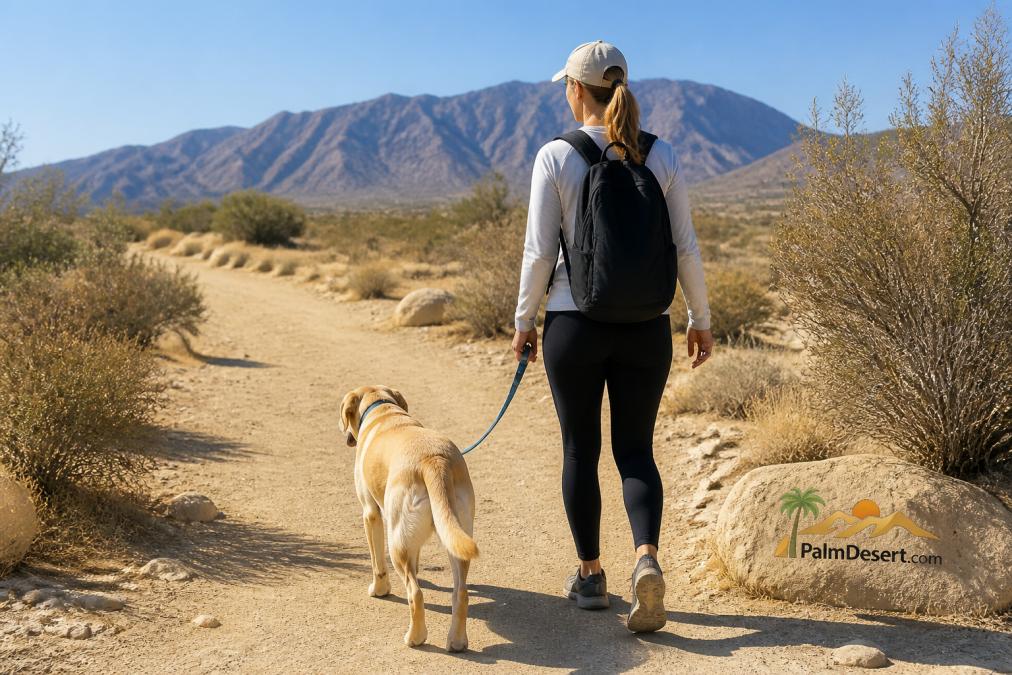
Homestead Trail is the gentlest introduction to desert hiking in the area, and the one most people should start with. It is a wide, sandy path that climbs gradually across the lower slope, with open sightlines the whole way, so your dog stays visible even on a long leash.
Trail Details: Distance, Elevation Gain, and Surface
|
Feature |
Detail |
|---|---|
|
Route type |
Out-and-back |
|
Surface |
Packed sand and gravel |
|
Elevation gain |
Gradual, low |
|
Shade |
Minimal, mostly open |
|
Best for |
Senior dogs, puppies, first-timers |
The payoff is the summit view across the valley floor toward the Little San Bernardino range. Go early: there is almost no shade on this route, and the sand reflects heat from below as well as above.
2. Bump and Grind Trail: A Moderate Loop for Active Dogs
Bump and Grind is the step up: a moderate-intensity loop with real elevation gain, rocky sections, and a steady climb that will genuinely work a fit, active dog. It is not the trail for a flat-faced breed, a senior dog, or a puppy whose joints are still developing.
3. Art Smith Trail: Shaded Canyons and Wildlife Watching
Art Smith Trail offers something the other routes here do not: shade. The lower canyon sections hold cooler air and give your dog relief from direct sun, stretching the usable hiking window by a couple of hours on either end of the day.
4. Randall Henderson Trail: A Natural Preserve With Leash Laws
Randall Henderson Trail sits inside a designated natural preserve, which changes the rules. Leash laws are enforced here, not suggested, and dog waste disposal is expected without exception. The upside is a well-maintained route through protected desert terrain with interpretive markers along the way.
5. Bear Creek Oasis Trail: An Out-and-Back With Summit Views
Bear Creek Oasis is the most rewarding of the five and the one that demands the most planning. It is an out-and-back route that gains elevation steadily toward a palm oasis, with summit views across the rugged landscape. The surface shifts between sand, rock, and loose gravel, so paw protection is worth considering if your dog is not used to desert terrain.
Desert Hiking Safety Tips for Dogs
Most guides stop at “bring water and go early.” That advice is correct but incomplete, and in desert conditions the missing details decide whether your dog finishes comfortably. Here is what actually matters, in order. Hydration systems must be reliable enough to prevent overheating, which is why choosing the right portable water bottles is essential for maintaining a steady flow during your trek.
Surface Temperature Is the Real Limit, Not Air Temperature
Air temperature is a poor proxy for what your dog’s paws are touching. Open sand and dark rock absorb solar radiation through the day and can run substantially hotter than the air above them, which is why a comfortable 80°F morning can still produce a surface that is uncomfortable within seconds. The practical test: place the back of your hand flat on the surface for five seconds.
Match the Trail to Your Dog, Not the Other Way Around
“Easy” is relative to the dog. A few patterns hold up well:
- Senior dogs and puppies: favor wide, packed-sand routes with gradual elevation gain and reliable shade. Short out-and-back formats let you turn around at any point.
- Flat-faced breeds (bulldogs, pugs, boxers, Boston terriers): their anatomy makes efficient cooling harder, so treat any sustained climb as a step above its posted difficulty. Shaded canyon sections and early starts matter more for these dogs.
- High-energy working breeds (shepherds, huskies, cattle dogs): they will happily overheat before they show it. Cap the distance even when they seem eager, and schedule water breaks rather than waiting for them to slow down.
- Double-coated northern breeds: the coat insulates against heat as well as cold, but they still need the same timing and water rules. Do not shave them for a hike.
Water: How Much and How Often
A common working rule among desert hikers is roughly one liter per person per hour, with a comparable share set aside for a medium-sized dog. Small dogs need less; large dogs in full sun need more. Offer water every 15 to 20 minutes rather than waiting for a rest stop, and use a collapsible bowl so your dog can drink normally.
Book Hotels with Exclusive Discounted Rates Now →
Paw Protection: What Works and What Does Not
Boots help on rocky, gravel-heavy routes and on any surface you cannot hold your hand against. The trade-off is fit: a loose boot causes more problems than bare paws, so break them in on short neighborhood walks first. Paw wax offers limited protection on hot rock and is not a substitute for timing. The most reliable protection remains hiking in the coolest hours and choosing routes with shade and softer surfaces.
Leash, Wildlife, and Waste
Leash laws apply on most routes in the area, and canyon terrain brings coyote awareness into play, especially at dawn and dusk. A standard six-foot leash gives you control without restricting the walk. Pack out all waste, required in designated preserves and expected everywhere else, and carry the bag rather than leaving it trailside for the return trip.
Know the Turn-Around Point Before You Start
Set a time or landmark as your turnaround and honor it even if your dog seems fine. Heat illness in dogs progresses faster than most owners expect, and the symptoms, heavy panting that does not settle, wobbling, drooling, refusal to continue, typically appear after the point where turning back is still easy. If you see them, stop in shade, offer water, cool the paws, belly, and groin with wet cloths, and do not continue.
After the Hike
Cool-down matters as much as warm-up. Offer water, check paws for cuts or hot spots, and let your dog rest in shade or air conditioning before the next activity. If you are building a full day around the hike, plan it around your dog’s recovery, a shaded patio, a quiet walk, and a long nap are the right sequence after a desert morning on the trail.
Best Time of Year to Hike With Dogs in the Coachella Valley
The best time to hike with dogs in the Coachella Valley is late fall through early spring, roughly November through March, when morning temperatures stay comfortable and trails are most forgiving. Winter is the prime window. Snowbirds arriving for the season will find this is also when the local hiking calendar is busiest, so early starts help with parking at popular trailheads.
Month-by-Month, in Practical Terms
- November-December: Cool mornings, mild afternoons. Most trails are comfortable from mid-morning onward, and shade is less critical. The easiest window for senior dogs and first-timers.
- January-February: The coolest stretch. Early starts can be genuinely cold, so bring a layer and consider a light coat for short-haired dogs. Trails are at their best and parking fills early on weekends.
- March-April: Warming quickly. Start at first light, finish by mid-morning, and favor routes with shade. Wildflower season draws crowds to popular trailheads.
- May-June: The transition months. The usable window shrinks to the first hour or two after sunrise. Surface temperatures on open sand climb well before air temperatures do, so paw checks matter more than the thermometer.
- July-September: The only sensible window is the first hour after sunrise, and even then only on the shortest, most shaded routes. Many experienced local hikers switch to valley-floor walks during the hottest months and save mountain trails for fall.
- October: The relief month. Mornings become comfortable again, though afternoons can still run warm. Treat it as a shoulder season and start early.
Parking and Trailhead Timing
Popular trailheads fill early on weekends and during snowbird season. Arriving 15 to 20 minutes before sunrise gives you a parking spot, cooler surface temperatures, and a quieter trail, which matters more for reactive dogs than most owners realize. If a lot is full, choose a different trail rather than parking on the shoulder or in a residential turn.
Building a Day Around the Hike
A desert hike with a dog works best as the first activity of the day, not the middle one. The pattern that holds up: hike at first light, finish before the heat builds, then move to a shaded, dog-friendly spot for water and rest. Plan the rest of the day around your dog’s recovery, a long nap in air conditioning beats a second outdoor stop.
Frequently Asked Questions
Are dogs allowed on hiking trails in the Coachella Valley?
Yes, dogs are allowed on many trails in the Coachella Valley, including the five easy dog friendly hiking trails in Palm Desert listed here. Most trails require dogs to stay on a leash no longer than six feet. Some natural preserve areas have stricter leash laws, so check posted signs at each trailhead before you start. Always carry waste bags and dispose of dog waste properly to keep trails clean and accessible for everyone.
What should I bring when hiking with my dog in the desert?
Pack more water than you think you need, for both you and your dog. Bring a collapsible bowl, a leash, waste bags, and paw protection if the ground is hot. A basic pet first-aid kit is smart for longer hikes. High-energy dogs may need a snack mid-trail. Avoid hiking during peak heat, and check the ground temperature with your hand before your dog walks on it. If it is too hot for your palm, it is too hot for paws.
How can I keep my dog safe on desert trails?
Start early in the morning when temperatures are lower and shade is available. Watch for signs of heat exhaustion in your dog, including heavy panting, drooling, and weakness. Keep your dog leashed to prevent encounters with coyotes, snakes, and other wildlife. Stick to marked trails and carry enough hydration for the full hike. After the hike, check your dog’s paws for cuts, burrs, or burns. Know your dog’s fitness level and choose trails that match it.
What time of day is best for hiking with dogs in this region?
Early morning is the best time for dog friendly hiking in Palm Desert, especially from October through April. Temperatures are cooler, shade is more available, and the desert terrain is easier on paws. Avoid midday hikes from May through September when heat exhaustion risk is high for both people and dogs. If you hike in warmer months, go at sunrise and keep the route short. Always bring hydration and take breaks in shade.