
Table of Contents
- Understanding California Residency vs. Domicile
- California Residency Day Count: The 183-Day Rule and Beyond
- Proof of California Residency Documents You’ll Need
- California Residency Without Buying a House
- Building Your California Residency Checklist
- Update Your Driver’s License and Vehicle Registration
- Tax Consequences for Part-Year and New Residents
- When to Seek Professional Help
- Frequently Asked Questions
Last Updated: October 19, 2026
Understanding California Residency vs. Domicile
California residency and domicile are not the same thing. Residency is about where you physically spend your time and maintain connections. Domicile is your permanent home, the place you intend to return to and consider your true home.
For tax purposes, California considers you a resident if you’re physically present in the state or if you’ve established a permanent home here with significant ties. Many snowbirds struggle with this distinction because they split time between locations.
You can have a domicile in one state while being a tax resident in another. California is aggressive about claiming residents: if you spend more than half the year here or maintain a permanent home and family ties, the state will likely consider you a resident even if you think of yourself as a temporary visitor.
The key is documenting your intent. If you’re establishing California residency as a snowbird, you need to show clear evidence that California is your primary home, not just a winter destination.
California Residency Day Count: The 183-Day Rule and Beyond
The 183-day figure gets repeated everywhere, but California does not use a simple day-count test. The governing rule is in California Revenue and Taxation Code §17016 and the Franchise Tax Board’s Publication 1031, Guidelines for Determining Resident Status.
What California Actually Tests
California presumes you are a resident if you are physically present more than nine months of the tax year (roughly 275 days), unless you can prove a temporary or transitory purpose, a much higher bar than 183 days. Separately, even if you are not present that long, California can treat you as a resident if you are domiciled here.
So there are two independent paths to residency:
- Domicile. You intend California to be your permanent home. Domicile does not change just because you travel; it changes when you form the intent to make a new place your permanent home and act on that intent.
- Physical presence plus temporary purpose. Even without California domicile, you can be treated as a resident if you are present for more than nine months and cannot show a temporary or transitory purpose.
A day count below 183 days helps, but it is not a safe harbor. The FTB looks at the totality of your connections, where your spouse and children live, where you vote, register cars, see doctors, license pets, keep a safe deposit box, and return after trips. The 183-day figure matters mostly because other states and the federal government use it, not because California treats it as a bright line.
Do not assume that staying under 183 days in California protects you. If California is your domicile, you can be taxed as a resident even if you spend most of the year elsewhere. Conversely, spending more than 183 days in California does not automatically make you a resident if you can show a temporary purpose, but the burden of proof shifts to you.
How California Counts Days
For the physical-presence test, California counts any day you are physically present, including partial days, a morning landing and evening departure still counts. Days spent purely in transit (a connecting flight where you never leave the airport) generally do not count, but the FTB scrutinizes this, so keep boarding passes and itineraries if you rely on it.
What to log for each day:
- Date and location where you slept
- Whether you were in California for any part of the day
- Purpose (personal, business, medical, family)
- Supporting record (credit card charge, receipt, calendar entry, flight confirmation)
A Practical Tracking Method
Most practitioners recommend a single source of truth. A shared spreadsheet with one row per day, updated weekly, works better than a travel app because you control the fields and can export it if the FTB asks. Pair it with:
- Credit and debit card statements showing where you spent money each day
- Cell phone location history (downloadable from your carrier or phone settings)
- Flight, train, and rental car confirmations
- Receipts for lodging, meals, fuel, and medical visits
- A calendar of recurring commitments (doctor appointments, church, clubs) in each state
Keep these records for at least four years after the tax year, California’s standard audit window, and longer if you have unreported income or filed a fraudulent return.
Snowbird Travel Scenarios and Day-Count Impact
These are illustrative patterns, not rules. The FTB looks at the whole picture, but the day count frames the conversation.
Scenario 1: Arrive in November, leave in April. Roughly 150-160 days in California, the classic snowbird pattern. Your day count supports a nonresident position, but only if your domicile and ties point elsewhere: a home, spouse, doctors, and voter registration in your other state.
Scenario 2: Arrive in October, stay through May. Roughly 210-240 days. You are above the 183-day line but below the nine-month presumption. California will look hard at whether your presence is temporary. Strong ties elsewhere (a permanent home, a spouse who stays, a business, a driver’s license) are essential.
Scenario 3: Three months, leave for two, return for two. Roughly 150 days spread across the year. Intermittent presence can weaken a nonresident case because it suggests California is becoming your base. Document why you returned, family, medical, business, and keep the pattern consistent year to year.
Scenario 4: 180 days one year, 200 the next. Trending upward matters. The FTB looks at patterns across years, not just the year under audit. If your California days are climbing, expect questions.
The strongest snowbird position is a consistent pattern: late-fall arrival, spring departure, a documented permanent home and civic ties in another state, and a day log you can produce on request. The weakest position is an inconsistent pattern with no records and a California driver’s license you never updated.
Franchise Tax Board Publication 1031, Guidelines for Determining Resident Status
Proof of California Residency Documents You’ll Need
When you establish California residency, you’ll need documentation supporting your claim, for tax filings, driver’s license applications, and potential disputes with tax authorities. Think of it as building a file: each document is a piece of evidence, and together they tell a clear story about where you live.
Book Hotels with Exclusive Discounted Rates HERE →
Primary Residency Indicators
These documents carry the most weight:
Driver’s license and vehicle registration. A California address on your license is strong evidence of residency, as is California vehicle registration. If you own a car registered here, update both to your California address, one of the first steps most snowbirds take.
Lease or property deed. A lease or mortgage showing your California address is powerful evidence; if you own a home, the deed is your strongest document. A lease signed by you and the landlord works well. Short-term rental agreements are weaker because they suggest temporary presence.
Voter registration. Registering to vote in California shows intent to establish residency, a deliberate act demonstrating you’re not just visiting, and one many snowbirds overlook.
Mailing address. Change your mailing address with banks, insurance companies, subscriptions, and other services. Use your California address. This creates a paper trail showing California is your primary contact point. Consistent documentation of your location also simplifies the process of preparing your RV for long-term storage when you are not actively traveling.
Supporting Documentation
These documents add weight to your case:
- Utility bills. Electric, water, or internet bills in your name at your California address
- Bank and financial statements. Statements showing your California address
- Health insurance. Coverage showing a California address or enrollment in a California health plan
- Employment records. If you work in California, pay stubs or employment contracts
- Property tax records. If you own property here, tax statements
- Membership documents. Gym memberships, club memberships, or organizational affiliations in California
- Medical records. Doctor or dentist records showing your California address
- Beneficiary designations. Life insurance or retirement accounts listing your California address as primary residence
Gather these documents and keep them organized. You may not need all of them, but having them available strengthens your position if California questions your residency status.
California Residency Without Buying a House
Many snowbirds assume they need to buy property to establish residency. They don’t, you can establish California residency by renting. A long-term lease is just as valid as a deed; the key is showing intent to stay for an extended period, typically a year or more. Month-to-month or short-term vacation leases are weaker because they suggest temporary presence.
If you’re renting, make sure the lease is in your name and lists your California address, sign it yourself, and pay rent from a California bank account if possible.
Alternatively, rent a small studio or one-bedroom apartment year-round even if you’re only there part of the year. This gives you a legal California address and a lease to show, often at a lower cost than you’d expect in a less expensive area.
The Visitor Center for Palm Desert & Palm Springs can help you explore housing options throughout the Coachella Valley. Whether you’re looking for a short-term winter stay or considering a longer lease, our resources can guide you to options that fit your needs.
Building Your California Residency Checklist
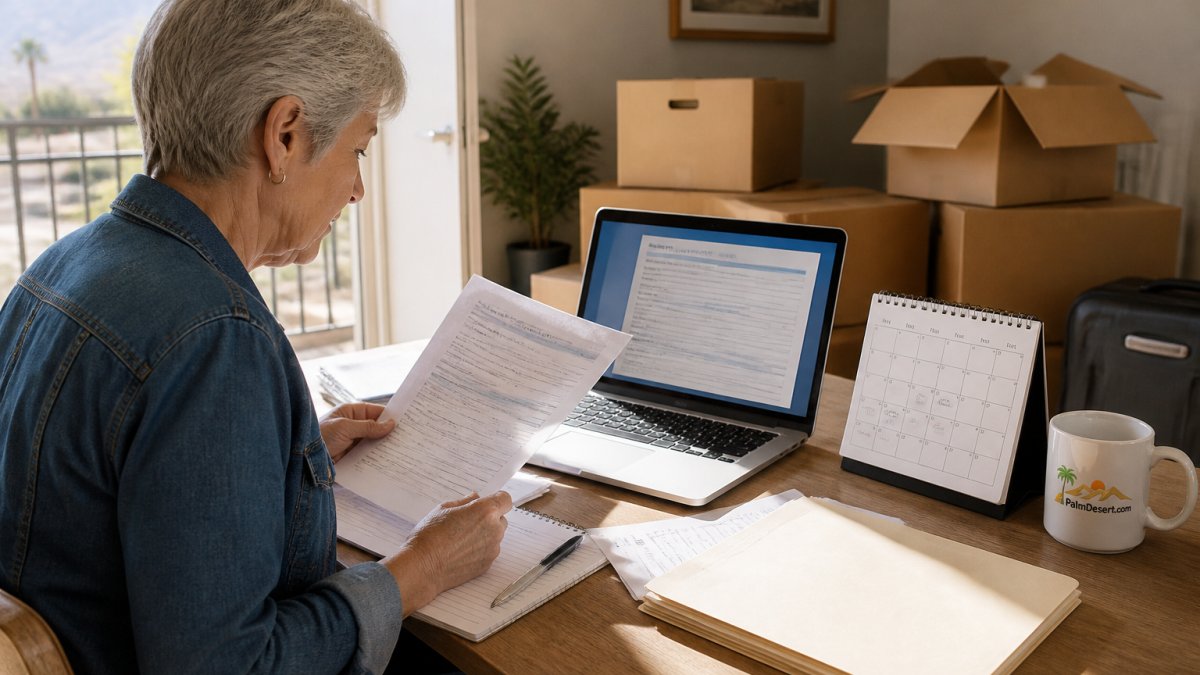
Establishing residency is a process. Breaking it into phases makes it manageable.
Pre-Move Preparation
Before you arrive in California, start these steps:
- Research California residency requirements and tax implications
- Gather documents proving your current residency elsewhere (lease, driver’s license, voter registration)
- Decide on your California address (rental, property purchase, or temporary arrangement)
- Notify your current state of your planned move
- Update your mailing address with key accounts (banks, insurance, employers)
- Research California driver’s license requirements
- Plan your move timeline and first arrival date
First 90 Days in California
Once you arrive, prioritize these tasks:
- Establish your California address (sign lease, close on property, or formalize rental agreement)
- Update your driver’s license and vehicle registration
- Register to vote in California
- Open a California bank account or update your address with existing banks
- Enroll in California health insurance or update your address with current provider
- Update your mailing address with all major accounts
- Establish utility accounts in your name
- Keep records of your arrival date and initial days in California
- Document your physical presence (receipts, photos, calendar entries)
Ongoing Maintenance
Throughout your residency, maintain these practices:
- Track your days in California monthly
- Keep utility bills and other documents showing your California address
- Maintain your voter registration and participate in elections
- Keep financial statements and tax documents showing your California address
- Update your address with any new accounts or services
- Document your family ties (spouse, children, parents in California)
- Keep records of employment or business activity in California
- Save receipts from California businesses, healthcare providers, and services
- Maintain proof of your permanent home status (lease, deed, or long-term rental agreement)
Update Your Driver’s License and Vehicle Registration
Your driver’s license and vehicle registration are among the first things California looks at to determine residency. Update these early.
To get a California driver’s license, you’ll need:
- Proof of California residency (lease, property deed, utility bill, or bank statement)
- Proof of identity (passport, birth certificate)
- Proof of Social Security number
- Your current driver’s license from another state
Visit your local Department of Motor Vehicles office with originals and copies of your documents. The process typically takes a few hours, including written and vision tests, and your new license arrives by mail within a few weeks. Update your vehicle registration at the same time; California registration requires proof of residency and proof of vehicle ownership.
Many snowbirds delay this step, worried about losing their out-of-state license or paying California vehicle taxes. But updating your license and registration significantly strengthens your residency claim, one of the clearest signals that you’re establishing California as your primary home.
Book Hotels with Exclusive Discounted Rates HERE →
Tax Consequences for Part-Year and New Residents
California taxes residents on worldwide income and nonresidents only on California-source income. Part-year residents are taxed on all income received while residents, plus California-source income received while nonresidents. Getting this wrong is the most common and most expensive snowbird mistake.
The Three Filing Categories
- Full-year resident. Domiciled in California for the entire year, or present for more than nine months without a temporary purpose. Files Form 540. Worldwide income is taxable.
- Part-year resident. Moved into or out of California during the year. Files Form 540 with Schedule CA (540) to separate California-source from other-source income, and computes tax on the residency-period portion.
- Nonresident. Domiciled elsewhere and not present long enough to trigger the presumption. Files Form 540NR. Only California-source income is taxable.
A snowbird who establishes California residency mid-year is a part-year resident for that year. A snowbird who was a California resident all year but traveled is a full-year resident, travel does not change the filing category.
What Counts as California-Source Income
For a nonresident or part-year resident, California taxes income with a California source. Common examples:
- Wages for work physically performed in California
- Business income from a California business or a California-located partnership/S-corp interest
- Rental income from California property
- Capital gains on the sale of California real property
- California-source retirement income in some cases (see below)
- California lottery winnings and certain other California-sourced items
Income from out-of-state work, out-of-state rentals, and most out-of-state investment income is generally not California-source for a nonresident. But once you are a California resident, all of it is taxable.
The Retirement-Income Trap
This is where snowbirds get surprised. California does not tax Social Security benefits, but it does tax most other retirement income, pensions, 401(k) and IRA distributions, and annuity payments, for residents. For nonresidents, California generally does not tax retirement income earned for services performed outside California, but the rules are fact-specific. If you have a pension from a career in another state and become a California resident, that pension becomes taxable here. Plan for it before you change domicile.
Do not assume that because you paid taxes on retirement income in another state, California will not tax it once you are a resident. California does not give a credit for taxes paid to another state on the same income if California is your state of residence. The credit-for-taxes-paid-elsewhere on Schedule S applies only in limited situations.
How the Part-Year Return Works
On Schedule CA (540), you separate income into three columns, California amounts, differences, and total, walking through each line of your federal return. The result is a California tax computed on the residency-period portion of your income, plus California-source income earned while a nonresident.
A few practical points most articles skip:
- Move-year timing matters. The date you establish or abandon California domicile drives the allocation. Document it with a lease start date, a utility connection, a driver’s license issuance, or a voter registration, not just a calendar note.
- Withholding is not residency. An employer withholding California tax does not make you a resident, and the absence of withholding does not make you a nonresident.
- Estimated payments. Part-year residents may owe estimated tax if their California liability exceeds the threshold. Plan for a first-year balance due.
- Credits for other states. California allows a credit for taxes paid to another state on income taxed by both, but the credit is limited and does not apply to income California taxes as a resident that the other state also taxes as a resident. This is a common source of double taxation for snowbirds who split time between two states that both claim them.
Records to Keep for the Tax File
- Your day log (see the day-count section)
- Lease, deed, or closing statement for each home
- Driver’s license and vehicle registration dates
- Voter registration confirmation
- Utility bills showing service start and end dates
- Moving receipts and a dated inventory of household goods
- W-2s, 1099s, and K-1s with state allocations
- Prior-year returns from every state where you filed
If you are establishing California residency mid-year, file as a part-year resident, allocate income by date and source, and keep a dated record of the move. If you are leaving California, the same logic applies in reverse, and the date you abandon domicile is just as important as the date you arrived.
Franchise Tax Board Schedule CA (540) instructions
When to Seek Professional Help
Some situations require professional guidance. Knowing when to call a tax professional or attorney can save money and headaches.
Consult a tax professional if:
- You’ve split time between California and another state for multiple years
- You have significant investment income or retirement distributions
- You own property or a business in multiple states
- You’re concerned California might challenge your residency status
- You’ve filed taxes as a nonresident but now want to establish residency
- You’re not sure whether you qualify as a part-year resident or full-year resident
- You’ve been audited by California or another state regarding residency
A tax professional who specializes in multistate taxation can review your situation, ensure you’re filing correctly, and help you build a strong residency position if California ever questions your status.
Consult an attorney if:
- California has formally challenged your residency status
- You’re involved in a dispute with tax authorities about your domicile
- You’re concerned about potential back taxes or penalties
- You want to formally establish your domicile in California or another state
An attorney can help you document your residency intent, respond to tax authority inquiries, and represent you if the situation escalates.
Establishing California residency as a snowbird requires planning and documentation, but it’s achievable. Understand the difference between residency and domicile, track your days carefully, and gather the documents that prove your California ties. The Visitor Center for Palm Desert & Palm Springs is here to support your transition, whether you’re looking for housing options through our vacation rental directory, exploring community resources, or planning your move timeline.

Frequently Asked Questions
How many days do you need to live in California to establish residency as a snowbird?
California uses a 183-day test, but residency is fact-specific and goes beyond simple day counting. If you spend 183 or more days in California during a tax year, you may be presumed a resident for tax purposes. However, the state examines your domicile, where you intend to make your permanent home, regardless of days spent. Snowbirds who maintain a primary home outside California while spending winters there may argue nonresidency if they can demonstrate intent to return elsewhere and keep stronger ties outside the state. Track your days carefully and document your out-of-state ties.
What proof of California residency documents do snowbirds need?
Key documents include a California driver’s license, vehicle registration, lease or property ownership records, utility bills, voter registration, and health insurance showing a California address. The state also looks at where your spouse and family members reside, where you own or lease a home, and employment location. Bank statements, mail forwarding records, and a calendar tracking your physical presence in California strengthen your case. No single document proves residency; the state weighs all factors together to determine your domicile and tax status.
Can you establish California residency as a snowbird without buying a house?
Yes. You can establish California residency by renting an apartment, leasing a condo, or even maintaining a long-term vacation rental. Home ownership is not required. What matters is demonstrating that you have a permanent home in California with a lease or rental agreement in your name, you spend significant time there, and you intend it to be your principal residence. A lease or rental contract showing your California address serves the same residency purpose as a deed. Combine this with a driver’s license, voter registration, and utility bills to build a strong residency case.
What should snowbirds know about California income taxes and residency status?
If you establish California residency, you must report worldwide income to the state. Part-year residents (those who became residents mid-year) report California-source income plus worldwide income for the months they were residents. Nonresidents report only California-source income. The state uses Form 540 (California resident return) or Form 540-NR (nonresident return) to determine your tax obligation. Consult a tax professional to file correctly and avoid audit risk based on your specific day count and domicile.